SK
 CZ
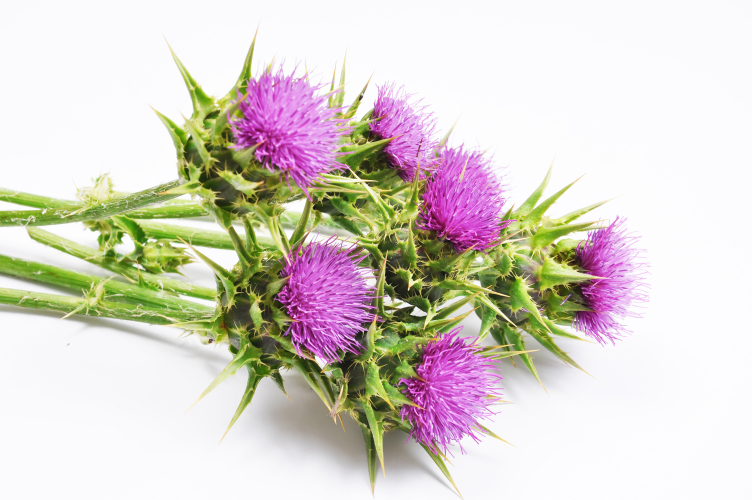
Slovak: Milk thistle Latin: Silybum marianum Czech: Milk thistle
Because of its prickliness, it has earned the folk name “Christ’s Crown” and is associated with the story of Christ’s crucifixion. Due to the white stripes on its leaves, it is also called “Mary’s thistle.” The stripes symbolize the milk of the Virgin Mary. It is said that a few drops of her milk fell onto the milk thistle’s leaves while she was nursing the infant Christ.
Milk Thistle – Cultivation and Harvesting
Milk thistle is rarely found in the wild; it is mainly found in gardens. Thanks to its appearance, it is often grown as an ornamental garden herb. Occasionally, however, it also grows along roadsides and on rocky slopes, where it can easily be mistaken for other thistles, such as the common thistle.
We harvest milk thistle leaves before the plant blooms, but only the nice, healthy, and richly colored ones. Care must be taken when harvesting, as the plant is very prickly. We harvest the fruits shortly before they are fully ripe.
Milk Thistle – Effects
The medicinal properties of milk thistle have been known since ancient times. Its primary use is for all types of liver diseases. It supports liver regeneration. At the same time, it benefits the gallbladder and the entire digestive system.
However, it also has other applications. It corrects circulatory disorders, helps with low blood pressure, tones the blood vessels, and has a beneficial effect on diseases of the cardiovascular system. It is also effective against migraines and dizziness caused by low blood pressure, and has a beneficial effect on lung tissue and the female reproductive organs.
It strengthens the body, treats various types of allergies, such as hives and hay fever, helps with asthma attacks, and relieves motion sickness.
Additional Health Benefits of Milk Thistle
In addition to its traditional use for the liver, modern research is uncovering other areas of application:
- Acne relief – An 8-week study with 210 mg of silymarin daily reduced acne by more than 50% (Source)
- Protection against chemotherapy – Studies in children with leukemia have shown that silymarin protects the liver from damage caused by chemotherapy drugs (Source)
- Metabolic syndrome – improves insulin sensitivity and helps with NAFLD (non-alcoholic fatty liver disease) (Source)

Milk thistle – use
It is safe in therapeutic doses; however, its use is not recommended in cases of very high blood pressure or during pregnancy.
In our herbal shops, you can also find it in the form of a tincture labeled Milk Thistle T30 or from the bud, labeled Milk Thistle P57.
Tea blend for a sluggish and “hardened” liver:
- crushed milk thistle seeds 5 parts
- milk thistle leaf 4 parts
- groundsel herb 3 parts
- burdock tops 3
- dandelion root 2
- chicory root 2
- St. John's wort herb 2
Add two tablespoons of the mixture to ½ liter of boiling water and, at the same time, add 1 teaspoon of finely ground milk thistle seeds. Stir, cover, and let steep for about 20 minutes. Strain and drink two to three times a day, 20–25 minutes before meals.
An interesting remedy is the so-called Rademacher tincture, which is based on the principle of the contribution of individual organs to the overall disease. For example, in cases of digestive problems, the liver, gallbladder (bile ducts), and stomach (gastric juices) are usually involved.
Very briefly put, the composition of the tincture is determined by the contribution of individual organs to the overall condition. If the gallbladder is functioning inadequately and accounts for 60% of the overall symptoms, we do not include a large amount of herbs that support liver function (milk thistle) in the mixture, but rather herbs that act on the gallbladder (celandine). If the stomach is the cause of the symptoms, we prioritize addressing this issue and use herbs that primarily affect the stomach (blessed thistle). By combining these three herbs (milk thistle, celandine, blessed thistle), we effectively address problems related to the digestive organs. Long-term results with Rademacher’s tincture to date have been excellent.
How should milk thistle be taken, and which form of milk thistle is most effective?
Since silymarin, the active ingredient in milk thistle, is fat-soluble, milk thistle oil is logically the most effective form. Furthermore, it contains the highest concentration of silymarin, directly in the carrier. However, because it is highly concentrated in this form, we do not recommend the oil for people with high blood pressure. Another highly effective form is a tincture made from the seeds or sprouts of P57 milk thistle. The tincture is highly concentrated, so just a few drops are enough to provide the body with a daily dose of silymarin. When taken with a meal, even a small amount of fat is enough to allow the active ingredient to reach the cells.
Milk thistle seeds are the last form we’ll discuss. They are either used to make an aqueous concentrate (by boiling them in water) or consumed as crushed seeds. In the case of crushed seeds, only a portion of the active silymarin can be absorbed in our digestive tract —specifically, the amount the body needs at that very moment. So if the body doesn’t need silymarin at the moment, very little of it will be utilized. If you do choose to use the seeds, you must always crush them first, because without crushing, they will simply pass through the digestive tract without being utilized.
Therefore, if you want to do liver cleansing treatments, I recommend concentrated forms of milk thistle.
If you have milk thistle in your garden and keep a dog at home, your dog will happily munch on the milk thistle flowers and fruits when it needs them, even though the flowers are prickly. Animals instinctively sense nature’s healing power. Let’s learn to perceive and feel it better ourselves.
Scientifically Proven Effects of Milk Thistle
The efficacy of milk thistle has been confirmed by numerous clinical studies:
- , a randomized study involving 97 patients with alcohol-induced liver damage, demonstratedits protective effect on the liver; a 4-week treatment with silymarin significantly reduced levels of the liver enzymes ALT and AST compared to a placebo.
- Its antioxidant effect was confirmed by a 6-month double-blind study in patients with chronic alcoholic liver disease, in which silymarin restored the antioxidant defense system by increasing the activity of superoxide dismutase and glutathione peroxidase.
- Its benefits for diabetes were demonstrated in a 12-month study involving 60 diabetic patients with cirrhosis, in which silymarin reduced levels of glycated hemoglobin and the need for insulin.
Source: https://pmc.ncbi.nlm.nih.gov/articles/PMC7140758/
How exactly does silymarin work in the body?
Silymarin acts as a protective shield for our liver. It contains six main active compounds—the most important of which are silybin A and B, which do most of the work. Imagine silymarin as three protective guardians who safeguard your liver in different ways:
1. The guard at the gates
Silymarin acts as a gatekeeper at the entrance to liver cells. When harmful substances (alcohol, medications, toxins) enter your body, silymarin “sticks” to the cell walls and forms a protective film. This prevents toxins from penetrating the cells and damaging them—much like a waterproof jacket protects you from the rain.
2. A Cleaner of Harmful Substances
Free radicals—aggressive particles that damage cells like rust damages metal—are constantly forming in the liver. Silymarin acts as a powerful “rust inhibitor”—it neutralizes these harmful particles before they can cause damage. At the same time, it helps the body produce glutathione—the body’s most powerful natural detoxifier.
3. A Master Builder for Regeneration
When liver cells are damaged, silymarin kick-starts their repair. It activates the cellular “protein factory” (RNA polymerase I), which begins producing the new building materials needed to repair and regenerate liver cells. It’s as if silymarin called in a construction crew to repair a damaged house.
Simply put: Silymarin simultaneously protects, cleanses, and repairs your liver—which is why it’s so effective for various liver problems.
Mgr. Dagmar Machničová and Ing. Pavol Machnič, editorial staff at www.zdravysvet.sk