SK
 CZ
In this article about the spring snowflake, you’ll learn:
Slovak: Prvosienka jarná, Latin: Primula veris, Czech: Prvosenka jarní, Common names: Peterkľúč, Petrov kľúč, primulka, kaška, prvnička
In other languages, such as French (a Romance language that mostly adopts Latin names), it is called “Primavere.” Similarly, in Italian and Spanish, it is known as “primavera,” “primola,” and “vellorita,” respectively... In German, it is called “Aurikel,” “Himmelschlüssel” (heavenly flower), “Schlüsselblume” (key flower), and “Osterblume” (Easter flower). In English, in addition to “primula” and “primrose” (from the Greek “polyanthus”), there is the unflattering name “oxlip” and “cowslip” (meaning “cow’s lip”), but also the lovely names “may-flower” (meaning “spring flower”) and “fairy primrose” (meaning “the first flower of the fairy”). In French and English, it is also known as “bear’s ear” (oreille d’ours and bear’s ear). Interestingly, in Russian as well, there is an “animal name”—“little ram”—in addition to “primula” and “pervocvet lekarstvennyj” or “aptečnyj” (meaning “medicinal primrose” or “pharmacy primrose,” derived from “apteka,” meaning “pharmacy”).
The primrose gets its name from the Latin *primus*—first—and *ver*—spring—which indicates that it is one of the first spring flowers. Folklore tells us that a primrose grew where St. Peter laid down his keys. That is why it was given the name “peterkľúč.” This name has also been adopted into the Czech language.
It belongs to the primrose family and is widespread throughout nearly all of Europe, as well as in the Near and Central East. This spring flower is protected in many countries. A related species, sometimes difficult to distinguish, is the bird’s-eye primrose (Primula elatior).
How to Identify the Spring Primrose
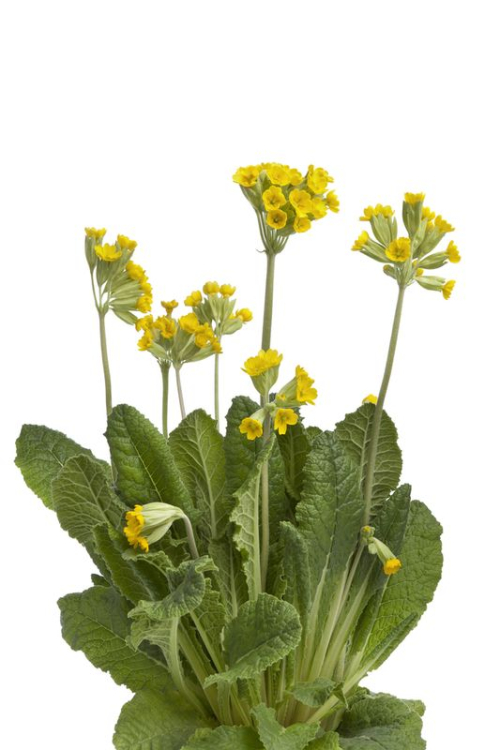
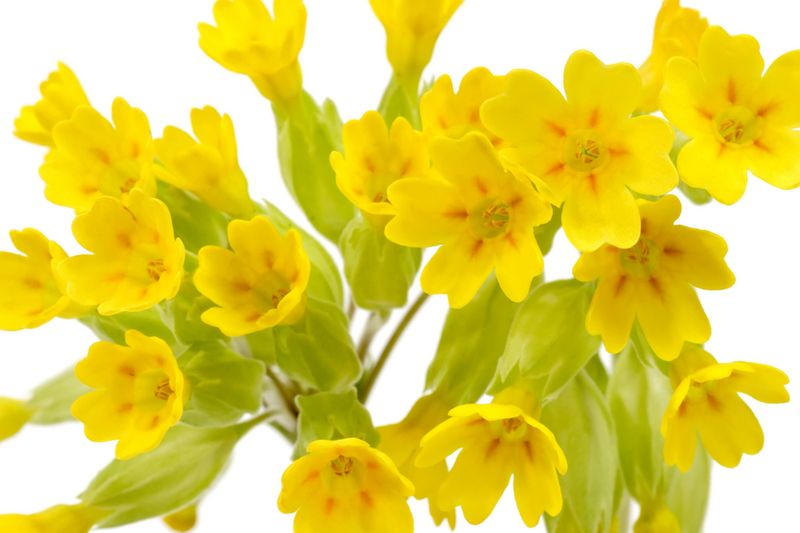
The Spring Primrose has egg-yellow flowers that are only slightly open, while the Greater Primrose has pale-yellow flowers that are wide open. However, no harm would come from mistaking one for the other, as both species are equally valuable and can be harvested for medicinal use.
The botanical name Primula veris (harbinger of spring) reveals that it has long been regarded in folk medicine as a remedy for protection and fertility.
The plant blooms from March through April.
A rosette of ovate to oblong basal leaves with serrated edges grows from a brown, cylindrical rhizome. A tall stem rises from the rosette on long petioles. It is best to harvest the flower with a piece of the stem immediately after it opens. Harvesting the root is not recommended; it is more labor-intensive, destroys the plant, and the herb is no more effective. Young leaves are sometimes used in spring salads.
This herb is rarely sold in pharmacies, so the main source is harvesting it yourself, or you can purchase it at our network of herbal shops and in our online store as Spring Primrose—flower, 30 g.
Effects of Spring Primrose
The main medicinal value of the spring primrose lies in its saponin content, which thins mucus in the bronchi and lungs, thereby making it easier to cough up.
In bronchitis, the bronchial walls are chronically inflamed and produce large amounts of mucus, which is expelled through a painful cough. Smokers are particularly at risk. Bronchitis can result from various causes. Most often, it is a secondary symptom or the result of a cold. It can also be caused by damage to the bronchi from smoking, chemical irritation, or harmful substances. Acute bronchitis, which lasts about 7 to 10 days, is characterized by a severe and painful cough and the expectoration of mucus. In the early stages, it is often accompanied by chills, difficulty breathing, and a high fever. Never forget that acute bronchitis must be treated by a doctor.
Primrose flowers are a good ingredient in inhalation mixtures for the respiratory system and in herbal baths.
The spring primrose also treats paralysis and gout, and is effective against stroke. Doctors and monks in the early modern period often prescribed it as a heart tonic, for colds, to treat urinary stones, and for wound care.
Its other beneficial properties include calming effects, which is why it is used as an ingredient in teas to combat stress, neurosis, migraines, and insomnia. In our herbal shops and online store, you’ll find it in the Migrenal and “Good Night” blends by the well-known Czech herbalist Valdemar Grešík, or in a special blend formulated to aid sleep called “Sleep Well.”
We do not take primrose internally in large quantities on its own, as it can cause nausea and vomiting. However, when used as part of teas made according to tried-and-true recipes, it can be consumed safely.
Tip from us: If you’re suffering from a persistent cough or need intensive support after recovering from viral or bacterial infections, in addition to primrose itself, you’ll also find our herbal liquid complex “Respiratory Tract” (200 ml). This potent blend of medicinal herbs is particularly suitable for deep lung regeneration and recovery from bronchitis. Thanks to an extra dose of licorice, it also excellently helps protect the body against herpes and cold sores.

Spring Primrose Tea
Tea blend for bronchitis:
50 g primrose flowers, 10 g wild chamomile flowers, 10 g coltsfoot flowers, 10 g elderflower, 10 g mallow flowers
Mix the tea blend well; pour ½ liter of boiling water over 1 tablespoon of the mixture, let it steep for 10 minutes, strain it, add honey and lemon, pour it into a thermos, and sip it throughout the day. At the same time, take 1 small teaspoon of onion juice 3 times a day.
Let’s not forget Hippocrates’ saying: “The doctor treats, nature heals.” Therefore, let’s cherish nature and make use of its gifts.
Compiled by Mgr. Dagmar Machničová www.zdravysvet.sk
References: Aurélia Dugasová and Dionýz Dugas—Grandma’s Herbs and Dionýz Dugas: 500 Best Recipes of Folk Medicine