SK
 CZ

1. Introduction: Berberine—Between “Herb” and Biological Agent
Berberine is a naturally occurring substance found in plants such as barberry (Berberis), goldenseal, and Coptis chinensis. Barberry (Berberis) is a medicinal plant that has been known for thousands of years in traditional medicine. It contains the active compound berberine, which has powerful biological effects. Traditionally, it has been used to treat digestive issues, infections, and intestinal problems. Modern research highlights its importance in regulating blood sugar, fats, and metabolism. Barberry is not just an “herb,” but a natural source of a compound that influences cellular function.
It serves as a bridge between traditional medicine and modern biology. From a chemical standpoint, berberine is an alkaloid. Interestingly, berberine was originally used primarily for infections and digestive problems, but modern research has gradually revealed a completely different aspect of it: its effect on glucose and fat metabolism and the energy balance of cells.
And this is where an interesting paradox begins.
On the one hand, it is a “herb,” a simple plant extract, but on the other hand, its effects in the body in some cases approach those of pharmacological drugs. It is no coincidence that berberine is often compared to drugs used for metabolic disorders, such as metformin.
This gives rise to a conflict typical of our times: is berberine just another overhyped supplement, or is it a substance with a real biological effect that has a place in modern medicine? The answer isn’t black and white, which is precisely why we’ll now take a closer look at berberine to confirm what we can realistically expect from it and debunk the nonsense that’s nothing more than a marketing gimmick.
WARNING: Even here, don’t choose based solely on price. My recommendation is: “Don’t buy berberine with a concentration below 97%. Lower concentrations work to some extent, but no one knows how.”
Form and Concentration of Berberine: The Decisive Detail
With berberine, it’s not just the substance itself that matters, but also its form and purity. There are various options on the market with differing concentrations, quality, and bioavailability. The most commonly used form is berberine hydrochloride (HCl), which is stable, well-researched, and used in clinical studies. It is for this form that we have the most data on effects and dosing.
However, not all products contain the same amount of the active ingredient. This means that when you buy a product, a seemingly lower price does not necessarily mean you’re getting a good deal. The differences lie in:
- in the concentration (e.g., 50%, 90%, 97–98%), in the quality of the raw material, and also in whether the manufacturer transparently declares the composition. This means thatthe same“mg on the label” does not automatically mean the same effect. Concentration is the most important factor.
In practice, therefore, it makes sense to check: what form of berberine the product contains, what its concentration is, and whether the manufacturer lists the actual active ingredient content.
For example, highly purified berberine hydrochloride with a concentration of around 98% is a form that closely matches the conditions used in clinical studies. Lower concentrations are not used in clinical studies.
Why This Is Important
If berberine is to work as described in the studies, it is not enough to simply “take berberine.” It is necessary for the form and quality to be comparable to those used in these studies.

2. How Berberine Works: AMPK as a Metabolic Switch
To understand why berberine is generating so much interest, it’s not enough to know that it “lowers blood sugar.” The key lies much deeper—at the cellular level.
One of the main mechanisms by which berberine exerts its effects is the activation of an enzyme called AMP-activated protein kinase (AMPK). This enzyme functions as the cell’s energy sensor —a sort of control unit that constantly assesses whether the cell has enough energy or is in “energy-saving mode.”
When energy levels are low, AMPK is activated and triggers a series of processes with a single goal: to restore balance and manage energy more efficiently.
What Happens After AMPK Activation
AMPK activation leads to several changes that are crucial from a metabolic standpoint: it increases cellular insulin sensitivity, reduces glucose production in the liver, promotes fat burning, and limits the storage of energy as fat reserves.
The body switches from “storage” mode to “utilization” mode.
Why This Is Important
In the modern world, the problem is often the exact opposite—chronic energy excess, insulin resistance, and disrupted metabolic regulation. AMPK is one of the main mechanisms through which the body attempts to correct this condition.
And this is where berberine comes into play. It’s not that it “supplies energy” to the body or functions as a traditional nutrient. Rather, berberine acts as a signal that tells the cell it needs to switch its metabolism to a more efficient mode.
Why It’s Compared to Metformin
Interestingly, the drug metformin—commonly used to treat type 2 diabetes—also utilizes a similar mechanism: the activation of AMPK. However, this does not mean that berberine is a “natural version of the drug” or a substitute for it. Rather, it shows that a natural substance can interfere with the same regulatory pathways as a pharmaceutical substance.
Berberine isn’t interesting just because it lowers blood sugar. It’s interesting because it influences the way a cell decides what to do with its energy. And that’s a fundamental difference.

3. What Clinical Studies Say: Where Berberine Has a Real Effect
The mechanism is one thing, but in practice, what always matters is whether the effect manifests in real people. This is precisely where berberine is interesting, because its effects are not limited to theory but are also evident in clinical observations.
Berberine and Blood Sugar Levels
Most of the data exists in the area of glucose regulation. Several studies show that berberine can lower fasting glucose levels, improve the long-term marker HbA1c, and increase cellular sensitivity to insulin. In people with insulin resistance or prediabetes, this effect is measurable and reproducible. Some studies have even shown a trend comparable to that seen with metformin treatment, although the mechanism and context of use are not identical. Therefore, anyone who knows they are at risk for diabetes should consider taking berberine.
Effects on Fat and Cardiometabolic Health
Berberine affects not only blood sugar but also fat metabolism. Studies have repeatedly observed a reduction in “bad” LDL cholesterol, a decrease in triglycerides, and a slight increase in “good” HDL. These changes suggest that berberine has a broader impact—on the entire cardiometabolic profile, not just a single blood test value.
The most potent berberine on the market, a natural support for metabolism, heart health... 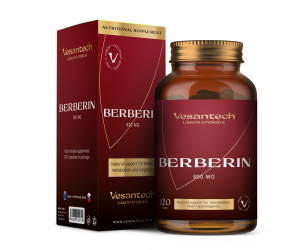
Weight and Body Composition
Let’s debunk the myth that it’s a fat burner. The effect on weight tends to be mild, but it may be of interest to some. It is therefore not a “fat burner” in the marketing sense. Rather, it’s a result of the body beginning to use energy more efficiently. That’s why some people experience a gradual weight loss with long-term use, as well as an improvement in fat distribution.
Berberine is therefore not a one-size-fits-all solution, but a tool that makes the most sense within a specific metabolic context. Berberine does not act as a “quick fix,” but rather as a gentle yet systematic intervention in metabolism, the effects of which become apparent only over time.
4. Bioavailability: The Main Problem with Berberine
One of berberine’s greatest limitations is its low bioavailability. After oral administration, only a small amount of the active ingredient is absorbed into the bloodstream. There are several reasons for this, but the main ones are poor absorption in the intestine, active “ejection” back into the intestine (via P-glycoprotein), and rapid metabolism in the liver.
This means that even when a person takes berberine, only a portion reaches the site where it is actually supposed to act. Therefore, in practice, higher doses spread out over the course of the day or technologically modified forms (e.g., combinations that improve absorption) are used.
However, this is often merely a marketing “value-add” rather than a scientifically substantiated synergy, as is the case when piperine is added.

5. Who Can Benefit from Berberine
Berberine is not a one-size-fits-all supplement. It is most beneficial in cases where metabolism is already disrupted in some way.
It is particularly beneficial for people with insulin resistance, those in the prediabetic stage, those with metabolic syndrome, or those with an impaired lipid profile.
In these situations, it can act as a supportive measure that helps the body return to more efficient functioning. Conversely, in young, healthy people with a balanced diet and sufficient physical activity, its effect may not be significant. In such cases, there is nothing to “correct” since the metabolism is functioning naturally.
6. Conclusion: The True Value of Berberine
Berberine is not a miracle herb, but neither is it “something” with no effect.
It is a substance that interferes with the body’s fundamental regulatory mechanisms— specifically, the way the body processes energy, sugar, and fats. Berberine is an example of how a natural substance can influence biological processes.
If berberine has a place, it is not as a quick fix, but as part of a broader context—namely, diet, exercise, and overall lifestyle. When we stop looking for simple answers and begin to understand metabolism, berberine, too, will cease to be a miracle and become a tool at our disposal.