SK
 CZ

Does this sound familiar?
Nausea, constipation, and black stools after taking iron aren’t your fault—and you don’t have to “get used” to them. In most cases, all you need to do is change when, how much, and in what form you take your iron. Find out why traditional tablets cause irritation, what’s secretly hindering your absorption, and how to choose a gentler supplement.
Your doctor tells you that your iron levels are low. You buy some pills, start taking them faithfully—and three days later, you feel sick to your stomach. Constipation sets in. Your stool turns black, and you get scared. After two weeks, you give up and tell yourself that iron just doesn’t agree with you.
You’re not alone in this, and it’s not your fault. Digestive issues are so common with traditional iron supplements that they’re the main reason people stop taking them prematurely. And what’s worse—many never go back to taking them, even though their bodies still need iron.
The good news is that in most cases, there’s something you can do about it. Not by gritting your teeth, but by changing when, how much, and in what form you take iron.
You’re not being overly sensitive—the numbers back this up
A systematic review and meta-analysis of randomized trials published in the journal PLOS ONE examined precisely this issue. It found that ferrous sulfate—the most common and cheapest form of iron in both supplements and medications—causes significantly more digestive problems in adults than a placebo.
We’re not talking about just a few percent. The differences between various forms of iron tend to be very pronounced in studies. For example, a comparison of ferrous sulfate with lactoferrin in pregnant women showed abdominal pain in 68% of women taking sulfate versus 18% with lactoferrin, constipation in 56% versus 14%, and black stools in 46% versus 2% (Al-Azhar Medical Journal).
So when someone tells you that you’ll get used to it—it may not be true. There are other options.
Who Is Most at Risk for Iron Deficiency
Before you start looking for a solution, it’s worth knowing whether you’re even in a high-risk group—because iron isn’t a supplement that everyone should take as a preventive measure.

Women of reproductive age. This is by far the largest group. It is estimated that 30–40% of women of reproductive age have suboptimal iron stores (Medicum). With heavier menstrual bleeding, iron loss adds up each month.
Pregnant and breastfeeding women. Iron requirements increase significantly during pregnancy because the body produces additional blood for the fetus. However, dosage during this period should be determined exclusively by a doctor.
People on a plant-based diet. Iron from plants is absorbed less efficiently than iron from meat, and its absorption in the intestine is further inhibited by phytates found in grains and legumes. This is not a reason to change your diet—just a reason to monitor your iron levels.
Athletes. During endurance training, iron is lost through the digestive tract and through the breakdown of red blood cells in the feet while running. A deficiency manifests itself in exactly the way an athlete attributes it to overtraining—a decline in performance and a longer recovery time.
Blood donors and people who have undergone surgery. Any significant blood draw or blood loss also means a loss of iron, which the body takes weeks to months to replenish.
Why Does Iron Actually Cause Irritation?
The principle is simpler than it seems.
Your body can absorb only a limited amount of iron from a single dose. When you take a high-dose tablet, most of the iron isn’t absorbed and passes on into the intestine. There, it irritates the mucous membrane, alters the composition of the gut microbiota, and causes exactly the symptoms you’re familiar with: nausea, cramps, constipation, or, conversely, diarrhea.
Black stools have the same cause and are not dangerous in and of themselves—they’re simply unabsorbed iron that has passed through the digestive tract. Nevertheless, they can be quite alarming if no one warns you about them in advance.
This leads to a fundamental point: a higher dose does not mean more iron is absorbed. It mainly means more iron in the intestine—and therefore more problems.
Hepcidin: A Hormone You’ve Probably Never Heard Of
Here we come to the most interesting part, which most iron supplementation guides completely omit.
Your body strictly controls how much iron it allows in. This is regulated by the hormone hepcidin, which is produced in the liver. When you take a dose of iron, hepcidin levels rise more than fivefold, peak after about eight hours, and remain elevated for another 24 hours—but not after 48 hours (WHO).
In practical terms: the dose of iron you take today impairs the absorption of the dose you take tomorrow.
Swiss researchers have verified this directly. With doses above 40 mg of iron, the absorption of the next morning dose decreased by 30–50%. And when the same total amount of iron was administered every other day instead of daily, the total amount absorbed was approximately 30% higher, and digestive problems were reduced by one-third (Stoffel et al., Lancet Haematology).
To be fair: a more recent meta-analysis of eleven randomized trials involving over a thousand participants did not show a statistically significant difference in final hemoglobin levels between daily and every-other-day dosing (PMC). So every-other-day dosing isn’t a miracle shortcut. But if daily iron makes you feel sick, it’s the first thing worth trying—you’ll likely achieve a similar result with better tolerability.
What’s Ruining Your Absorption Without You Even Knowing It

Even gentle iron in the right dose can go to waste if you wash it down with the wrong drink.
Coffee and tea. The polyphenols in these beverages bind iron directly in the intestine into insoluble complexes that the body cannot utilize. In a controlled study, beverages containing 20–50 mg of polyphenols per serving reduced iron absorption from a bread-based meal by 50–70%; with 100–400 mg of polyphenols, the reduction was 60–90% (Hurrell et al., British Journal of Nutrition).
And here’s the surprising part: it’s not just black coffee and black tea. In the same study, mint tea reduced iron absorption by 84%, cocoa by 71%, and even chamomile tea by 47%. Adding milk to coffee or tea had virtually no effect on this outcome.

This effect is caused by so-called galloyl groups in tannins. Their impact is dose-dependent—five milligrams of tannic acid reduced iron absorption by 20%, 25 mg by 67%, and 100 mg by as much as 88% (Brune et al., European Journal of Clinical Nutrition).
The good news: timing is key. A controlled study using stable iron isotopes in healthy women compared tea consumed with a meal to tea consumed one hour after a meal. The inhibitory effect dropped from 37.2% to 18.1% —roughly by half (The American Journal of Clinical Nutrition).

Calcium. Dairy products and calcium supplements compete with iron for the same absorption pathways. Do not take them at the same time.
Whole grains and legumes. They contain phytates, which bind iron in a similar way to polyphenols. There’s no reason to eliminate them from your diet—just don’t combine them with a dose of iron.
Vitamin C works in the opposite way. Ascorbic acid converts iron into a more easily absorbed form, and its effect is remarkably strong. In a study of young women, vitamin C increased iron absorption by 270% at a molar ratio of 2:1 to iron and by 343% at a ratio of 4:1 (The American Journal of Clinical Nutrition). That is why vitamin C is intentionally added to high-quality iron supplements.
A practical rule to remember: wait at least one hour—ideally two—between drinking coffee or tea and taking your iron supplement.
Gentler Forms of Iron
If you’ve tried everything mentioned above and still feel sick, the problem isn’t the timing, but the form of iron itself.
Plant-based iron from curry leaves
Instead of inorganic salt, the iron is derived from the leaves of the Murraya koenigii plant (curry tree). It therefore comes in a plant-based matrix, naturally accompanied by vitamin C and other compounds, which tends to be gentler on the digestive tract than concentrated salt. A randomized study using plant-based iron and vitamin C showed a significant improvement in hemoglobin levels in adults compared to a placebo (PMC).
Lactoferrin

Lactoferrin is an iron-binding protein naturally found in breast milk. It does not function like a traditional iron supplement—it helps the body regulate and utilize the iron it already has, rather than flooding it with a large dose.
A randomized study in iron-deficient pregnant women found a 2.26 g/dL increase in hemoglobin after two months with lactoferrin versus 1.11 g/dL with ferrous sulfate, with significantly fewer digestive problems reported with lactoferrin (PubMed).
And now, what most sellers won’t tell you: the results are not consistent. Another study in non-pregnant and non-breastfeeding women concluded that ferrous sulfate was more effective than lactoferrin in correcting iron deficiency —although, once again, it was associated with more digestive problems (PMC).
The conclusion, therefore, is straightforward: lactoferrin is an interesting option, especially for people who cannot tolerate conventional iron supplements. It is not automatically more effective for everyone.
Liposomal Form
Liposomes encapsulate iron in a thin lipid layer, which transports it through the digestive tract with less direct contact with the mucous membrane. Therefore, this form is generally better tolerated by those with sensitive stomachs.
How to do it in practice: seven steps

- Have your ferritin levels checked, not just your complete blood count. Hemoglobin levels may still be within the normal range even as iron stores are already declining. Without this number, you’re taking supplements blindly.
- Don’t increase the dose if you “don’t feel anything.” This doesn’t workwith iron—a higher dose mainly means more unabsorbed iron in the intestines.
- Try taking it every other day. If a daily dose causes you discomfort, split the same total amount between every other day.
- Avoid coffee, tea, milk, and calcium for at least one to two hours before or after taking your iron supplement.
- Add vitamin C or choose a supplement that already contains it.
- If you feel sick on an empty stomach, take the dose with a meal. Absorption will be slightly lower, but the dose you actually take is always better than the one you skip.
- If none of this helps, change the form of the supplement—not your commitment.
How to Choose a Supplement
There are three practical options on the market, and each suits a different person.
If you have trouble swallowing tablets or are looking for a form suitable for the whole family, Vesantech Iron Gummies —with natural iron from curry leaves, supplemented with vitamins B2 and B6—are the solution. The recommended dose is one gummy twice a day after a meal; for children ages three and up, one per day. A 30-day supply costs €20.
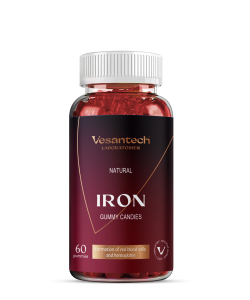
A delicious dietary supplement containing natural iron from curry leaves.
If you have a sensitive digestive system or an increased need for iron —during menstruation, pregnancy, breastfeeding, or intense physical activity— Vesantech Iron + Lactoferrin is a good choice. It combines plant-based iron with lactoferrin, vitamin C, copper, and active forms of vitamins B9 and B12 (5-MTHF and methylcobalamin), which can be utilized even by people with limited ability to metabolize folic acid. The recommended dose is two capsules in the morning on an empty stomach; a 30-day supply costs €32.
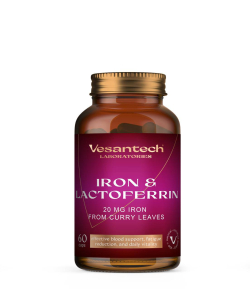
Iron with Lactoferrin – Modern Support for Blood Formation, Energy, and Immunity.
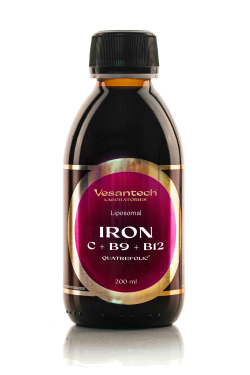
If you’ve had trouble with tablet forms in the past, Liposomal Natural Iron is worth considering, as its liposomal coating reduces direct contact between the iron and the mucous membranes.
Regardless of your choice, one thing is certain: don’t judge a supplement after just one week. Iron stores are replenished over months, not days, and a follow-up blood test makes sense no sooner than eight to twelve weeks later.
When to See a Doctor
A dietary supplement is no substitute for a medical examination. Always see a doctor if:
- fatigue lasts longer than a few weeks and does not improve with rest,
- you have heavy or prolonged menstrual bleeding,
- you notice blood in your stool or have persistently dark stools without taking iron supplements,
- you have been diagnosed with a digestive tract, kidney, or thyroid disorder,
- you are pregnant or breastfeeding—iron dosage during this time should be determined by a doctor,
- you are taking blood thinners, antacids, or antibiotics.
Iron is not actively excreted from the body, so an excess of it is just as problematic as a deficiency. Do not take high doses without a laboratory-confirmed reason and without medical supervision.
Frequently Asked Questions About Iron
Why do I have black stools after taking iron?
This is unabsorbed iron that has passed through the digestive tract. It is not dangerous in itself and will go away once you stop taking the supplement. However, if your stool remains black even after you stop taking iron, see a doctor.
Should I take iron on an empty stomach or after a meal?
More is absorbed on an empty stomach, but this often causes nausea. If you feel sick, take the dose after a meal—slightly lower absorption is better than missing doses.
Is it really enough to take iron every other day?
With the same total amount, you’ll likely achieve a similar effect with fewer side effects. However, always consult your doctor before changing your dosage, especially if you’re taking iron on their recommendation.
How long does it take for iron stores to replenish?
Hemoglobin levels usually respond within a few weeks, while ferritin stores take several months to replenish. Do not stop taking the supplement as soon as you start feeling better.
Can I take iron with coffee?
It’s not recommended. The polyphenols in both coffee and tea can reduce iron absorption by tens of percent. However, a one-hour interval is sufficient—in a controlled study, this reduced tea’s inhibitory effect by about half.
Is herbal tea safer than black tea?
Only slightly. In one study, peppermint tea reduced iron absorption by 84%, cocoa by 71%, and chamomile by 47%. If you’re taking iron, the same waiting period applies to herbal teas as well.
Are iron gummies just as effective as capsules?
What matters is the amount and form of iron, not the shape of the supplement. Gummies have the advantage of actually being taken regularly—and consistency is more important with iron than a single high dose.
Can children take iron?
According to the manufacturer, Iron Gummies are suitable for children ages three and up at a dose of one gummy per day, while capsules with lactoferrin are suitable for children ages 12 and up. However, it’s always best to consult a pediatrician when it comes to children.
What is ferritin, and why is it more important than hemoglobin?
Ferritin indicates the body’s iron stores. It can be low even when hemoglobin levels are within the normal range—and that’s precisely when fatigue sets in, which most people attribute to stress or lack of sleep.
Will adjusting my diet help instead of taking a supplement?
For a mild deficiency, dietary changes may be sufficient. Iron from meat is absorbed better than iron from plants; for plant-based sources, combining them with vitamin C helps. However, if a deficiency is confirmed, dietary changes alone are generally not enough.
Sources
- Tolkien Z. et al., 2015, PLOS ONE —systematic review and meta-analysis: ferrous sulfate causes significantly more digestive problems in adults compared to a placebo.
- Al-Azhar Medical Journal, 2020 (WHO EMRO) – a comparison of lactoferrin and ferrous sulfate in pregnant women, including the incidence of abdominal pain, constipation, and black stools.
- Stoffel N. et al., 2017, Lancet Haematology - alternate-day dosing increases iron absorption and reduces the incidence of gastrointestinal side effects.
- WHO, presentation by M. Zimmermann, 2020 —the hepcidin response to an iron dose and its effect on the absorption of the next dose.
- Systematic review and meta-analysis, 2025, PMC —11 randomized trials (n = 1,014): there was no statistically significant difference in hemoglobin levels between daily and every-other-day dosing.
- Hurrell R. et al., British Journal of Nutrition —beverages containing polyphenols reduce iron absorption from food by 50–70%.
- Association of Coffee and Tea with Ferritin, PMC —coffee consumed after a meal reduced iron absorption by an average of 39%.
- Rezvani M. et al., 2015, Journal of Obstetrics and Gynecology —an increase in hemoglobin of 2.26 g/dL with lactoferrin versus 1.11 g/dL with ferrous sulfate.
- Randomized study, PMC – in nonpregnant and nonlactating women, ferrous sulfate was more effective than lactoferrin, but with a higher incidence of adverse effects.
- Efficacy of Plant-Based Iron and Vitamin C in Adults, PMC —plant-based iron with vitamin C significantly improved hemoglobin levels compared to placebo.
- Brune M., Rossander L., Hallberg L., European Journal of Clinical Nutrition —the inhibition of iron absorption by tannic acid is dose-dependent: 5 mg by 20%, 25 mg by 67%, 100 mg by 88%.
- Ahmad Fuzi S. et al., The American Journal of Clinical Nutrition, 2017 – a one-hour interval between a meal and tea reduced the inhibitory effect from 37.2% to 18.1%.
- Thankachan P. et al., The American Journal of Clinical Nutrition —vitamin C increased iron absorption by 270% (2:1 ratio) to 343% (4:1 ratio).
- Medicum - Iron for Women - an estimate of the prevalence of suboptimal iron stores in women of reproductive age.
Disclaimer: This article is for informational purposes only and is not a substitute for professional medical consultation. Dietary supplements are not medications and do not replace a varied and balanced diet. Take iron based on laboratory test results and a doctor’s recommendation, especially during pregnancy, while breastfeeding, in children, and in cases of chronic illness.
Images used: Perplexity AI,
Author, Martin Kolčák, Zdravý svet