SK
 CZ
1. Are you low on iron? Your body may be telling you this long before you develop anemia
You feel tired in the morning. You wake up and already wish you could go back to sleep. You get out of breath more easily than before when climbing stairs, your hands and feet are cold, you have trouble concentrating, your hair is falling out, or you feel like your brain just isn’t working at 100 percent?
One of the biggest misconceptions about iron deficiency is the idea that iron deficiency equals anemia. They’re not the same thing. Anemia can actually be a later consequence of long-term iron deficiency. The body has its own reserves and can maintain hemoglobin within the normal range for a certain amount of time, even as its iron reserves gradually deplete.
One indicator of these “iron reserves” is ferritin —a protein that stores iron in the body. Therefore, a person’s hemoglobin level may still be normal, but their ferritin level may already be low. We are thus talking about iron deficiency without anemia. And this condition can manifest long before classic anemia appears in a blood test.
However, there’s another catch. Even ferritin isn’t a perfect indicator, because a person may have an inflammation, with ferritin levels that appear “normal” at first glance, yet the availability of iron to the cells may still be insufficient. That’s why, in unclear cases, we also look at other parameters, such as transferrin saturation, CRP, and the complete blood count.
And now we come to the most interesting part.
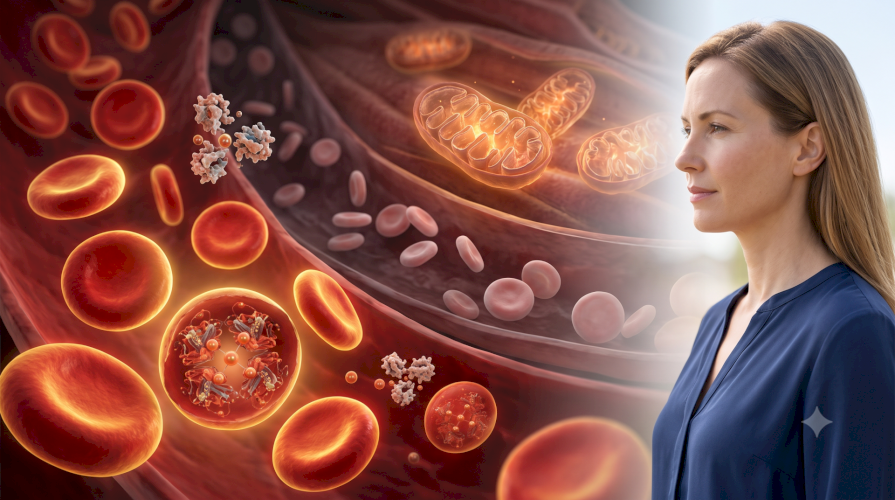
We don’t just need iron to produce hemoglobin. Mitochondria also need it to produce energy (and few people know this), as do muscles, enzymes, and the nervous system. When iron levels start to run low, the body has to decide where to send it first.
And you may feel the effects long before your doctor diagnoses you with anemia.
That’s why we shouldn’t automatically attribute fatigue, weakness, impaired concentration, or an unexplained decline in performance to age or stress, because the question isn’t just how much iron we have in our blood, but also how much we have stored, how much is available, and whether our cells can actually use it properly.
And that’s much more fascinating biology than it seems at first glance.
2. Iron isn’t just about blood. Without it, cells lose energy.
When people hear “iron,” most think of blood and hemoglobin. That’s correct, but it’s only half the story. We need iron not only to transport oxygen to our cells but also so that our cells can use it to produce energy. And that’s where our old friends , the mitochondria—the cells’ tiny power plants—come into play.
Iron is a component of the proteins and enzymes in the respiratory chain, through which mitochondria produce ATP. In other words: iron helps deliver oxygen to the cell and then helps the cell use that oxygen to produce energy. If I had to compare it to something, it’s a bit like bringing gasoline to a gas station while also needing it in the engine itself.
Without iron, both the transportation system and the power plant can start to falter.
The brain notices this very quickly, too. It’s one of the body’s most energy-demanding organs, and it needs iron for normal nervous system function and the production of certain neurotransmitters. That’s why a deficiency may not just manifest as paleness or shortness of breath. Fatigue, poor concentration, and slowed thinking may set in, as well as that familiar sensation of “brain fog”— which I discussed in my article “Brain Fog” and in a video on Instagram and Facebook.
You might then think to yourself: “I’m exhausted. I have no motivation. I probably need a vacation.” Maybe so, but sometimes it’s not just you who needs a vacation—your mitochondria need a break too, which means they need iron.
That’s why it’s a mistake to view iron merely as a “mineral for the blood.” It’s one of the fundamental components of the entire body’s energy system.

3. Why Iron Levels Drop—and Why Women Are a Special Case
Iron has one unpleasant characteristic: the body is very good at managing it, but it lacks any elegant mechanism by which lost iron would be replenished on its own. When we lose it—for example, through bleeding—we must replenish it.
And that is precisely why women are at a significantly higher risk of iron deficiency.
Every menstrual period means a loss of blood—and with it, iron. During heavier or longer periods, these losses can be substantial.
Add to that pregnancy, during which the need for iron increases dramatically for the mother, the placenta, and the developing baby, and reserves can be depleted much faster than a woman can replenish them.
However, menstruation isn’t the only culprit. A deficiency can also arise from low iron intake, intense endurance sports, a vegetarian or vegan diet, or even when we consume enough iron but the intestines simply cannot absorb it properly. The problem may stem, for example, from certain digestive disorders or chronic bleeding that a person may not even notice.
In this case, there’s a very important rule: If you repeatedly take iron supplements and your levels drop again, it’s not enough to just buy another package. You need to find out why, because sometimes iron is actually present in the body, but it remains “locked away in storage” and the cells can’t access it.
The key to this “warehouse” is held by a fascinating molecule that most people have never heard of.
It’s called hepcidin.

4. Hepcidin: The Little Guardian That Decides How Much Iron We Let Through
So let’s now turn to one of the most interesting characters in this whole story— hepcidin, which most of you haven’t heard of yet.
It’s a hormone produced mainly in the liver and acts a bit like an iron gatekeeper. When hepcidin levels are high, it limits iron absorption from the intestine and also makes it harder for iron to be released from storage into the bloodstream. So iron may be present in the body, but it remains, as it were, locked away in storage.
And what does hepcidin increase? Primarily inflammation. It’s actually part of the body’s natural defense mechanism—during an infection, the body doesn’t want to provide iron to microorganisms. The problem arises when inflammation persists over the long term. Interestingly, even the iron dose itself can temporarily increase hepcidin levels. That’s why the simple rule “the more iron and the more often, the better” no longer applies today .
And here we finally come to the molecule that fascinates me most in this story: lactoferrin. This is because the modern perspective on iron supplementation is no longer just about the question, “How many milligrams of iron does a capsule contain?”
A much more interesting question is: “What actually happens to that iron in the body?”
5. Lactoferrin: When We Add Not Just More Iron to Iron, but Its Biological Partner
And now comes, in my opinion, the most interesting part of the whole story of iron and anemia.
Lactoferrin is a natural protein capable of binding iron very tightly. It is found in bodily secretions, and its presence in breast milk—especially in colostrum—is particularly interesting. Nature, therefore, has long “understood” that a highly reactive element like iron must be handled in a very sophisticated manner.
Lactoferrin is not merely an ordinary transporter. It is involved in the body’s iron metabolism, immune response, and inflammation.
And it is precisely the relationship between lactoferrin, inflammation, hepcidin, and iron that is currently the subject of great scientific interest.
Clinical studies and meta-analyses show promising results for parameters such as hemoglobin and ferritin, and its good gastrointestinal tolerance is also noteworthy— meaning you may not feel sick after taking iron with lactoferrin.
And this completely changes the way we can view supplementation. Instead of asking, “How can we pack as much iron as possible into a capsule?”
we can ask:
“How can we create the conditions so that the body can utilize it as effectively as possible?”
That’s exactly why we didn’t base our new iron with lactoferrin solely on iron itself. We combined it with lactoferrin and other substances that play a biologically meaningful role in iron metabolism.
Because when it comes to iron, sometimes it’s not just how much we consume that matters , but what the body can do with it. And that’s where I see the greatest benefit of lactoferrin.

6. Not all iron is the same. Its source also matters.
If you turn over most iron supplements, you’ll find names like ferrous sulfate, ferrous fumarate, or iron bisglycinate on the label. These are different iron compounds, and each has its own properties, benefits, and limitations.
We’ve decided to take a different approach.
In our Natural Iron and Iron Gummies, we use plant-based iron derived from curry leaves (Murraya koenigii). The plant absorbs minerals from the soil and incorporates them into its natural plant matrix. The result, therefore, is not a classic isolated ferrous salt, but a source of iron derived from plant biomass.
And that’s the philosophy we embrace at our company—not just focusing on the number in milligrams, but also on where the iron comes from and in what form we consume it.
For people who prefer a plant-based source, we’ve therefore created Iron Gummies with natural iron from curry leaves. And if we want to go even further and look at how the body manages iron itself, we have iron combined with lactoferrin, which we discussed in the previous chapter.
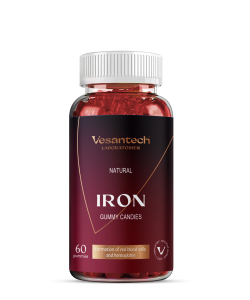
A delicious dietary supplement containing natural iron from curry leaves.
Because when it comes to iron, there’s more than just one question:
“How many milligrams does it contain?”
Equally important may be:
“Where does it come from, how do I tolerate it, and what can my body do with it?”
And that’s exactly where modern iron supplementation begins to differ from the simple rule “the more iron, the better.”

7. Iron isn’t a vitamin you should take “just in case”
We have a strange habit when it comes to iron. When we’re tired, we start taking supplements. If that doesn’t work, we increase the dose. And if it still doesn’t work, we try a different brand.
But iron isn’t candy.
It’s a vital element that the body manages very carefully. That’s why supplementation makes sense primarily when we know that iron is actually lacking—and why it’s lacking. A complete blood count, ferritin, transferrin saturation, and, depending on the situation, CRP can tell us much more than just a feeling of fatigue.
And if the deficiency keeps coming back, let’s not just keep looking for a stronger pill. Let’s look for the cause: blood loss, poor absorption, inflammation, diet, or a problem with iron metabolism.
Because after all this talk about iron and anemia, the most important thing to understand is this:
that when it comes to anemia, the future may not lie in taking more and more iron supplements. The future may lie in learning to understand iron better.
To understand at least a little about its origin, absorption, ferritin, hepcidin, or inflammation—but also about molecules like lactoferrin, which show us that human biology is far more sophisticated than the number listed on the back of a box.
Because it’s not enough to just put iron in a capsule. It’s not even enough to get it into the stomach.
We have to get it where the body actually needs it—into the life of our cells.
And perhaps that is precisely where ordinary “iron supplementation” ends and a true understanding of anemia begins. I hope you enjoyed my article and took away at least a few valuable tips for your health.