SK
 CZ

For several years now, we’ve been hearing about the importance of probiotics. Advertisements, pediatricians, and even the internet all say the same thing: “good bacteria” are the key to health. But very few people understand what probiotics actually are—and that they aren’t the only way to support gut balance.
A New Term for Many: Postbiotics
Alongside terms like probiotics and prebiotics, the term “postbiotics” is appearing more and more frequently in the scientific literature. Unlike live bacteria, postbiotics are their inactivated forms and their biologically active metabolites —and yet they have powerful health benefits.
It sounds like a paradox:
Dead bacteria that have a powerful effect? Yes . And in children, they’re often even safer.
Why is this particularly important for children?
Children have an immature immune system, a sensitive digestive tract, and a microbiome that is still developing. That’s why it’s important to know when and what type of “good bacteria” to give—and when a postbiotic is the better choice.
All too often, parents reach for probiotics without understanding their composition, quality, effects, or suitability.
In this article, we’ll explain:
what the difference is between probiotics, prebiotics, and postbiotics,
how inactivated strains work,
why postbiotics are sometimes a better choice for children,
and how this led to the development of a meaningful concept for two unique children’s products:
VESANTECH® KIDS and VESANTECH® KIDS PLUS.
Get ready for a simple yet scientifically grounded explanation of a topic that can significantly impact your child’s immunity, digestion, and overall health.

2. The Gut and Immunity—What Does a Child’s Microbiota Affect?
Immunity is born in the gut. Literally.
The gut microbiota is a collection of microorganisms that colonize our intestines —it plays a role in the body that we have long underestimated. Today we know that the gut is not just a “digestive tube.” It is a living, intelligent organ that:
communicate with the brain, shape the immune system, regulate inflammation, and even influence mood, behavior, and sleep.
Children’s gut microbiota: a sensitive ecosystem.
The development of the gut microbiota in children begins at birth. It is influenced by: the method of delivery (C-section vs. vaginal birth), breastfeeding (breast milk contains special oligosaccharides that act as prebiotics), antibiotics, diet and stress, the environment, and hygiene
If the gut microbiota becomes disrupted, this may manifest as the child experiencing:
more frequent infections, digestive problems (bloating, diarrhea, constipation), skin conditions (eczema), food intolerances, weakened immunity, or, conversely, excessive immune responses (allergies, autoimmune diseases)
The Gut and the Brain: A Stronger Connection Than We Realize
The gut microbiota communicates not only with the immune system but also with the brain—via the nervous system (the vagus nerve) and through the production of neurotransmitters (e.g., serotonin, GABA).
A healthy gut = better sleep, mood, concentration, and stress management.
That’s why children’s guts need:
gentle support—without unnecessary interventions, safe forms of “good bacteria,” and a regular intake of nutrients that support the growth of the right strains
3. Probiotics, prebiotics, postbiotics—what’s the difference between them?
These three terms are often confused or misunderstood—but each represents a different mechanism for supporting gut health:
Probiotics – live “good bacteria”
These are live microorganisms that, when consumed in sufficient quantities, provide health benefits. They are most commonly bacteria of the genera Lactobacillus and Bifidobacterium. They need to survive the journey through the digestive tract, colonize the gut, and “work” to benefit our health.
They are highly sensitive to temperature, stomach acid, and medications (especially antibiotics). Their advantages lie in their direct interaction with the gut microbiota, which they actively support. However, they can sometimes pose risks for particularly sensitive individuals: certain strains may be unsuitable for high-risk groups (immunocompromised children).
Prebiotics – Food for Probiotics
These are indigestible fibers (e.g., inulin, GOS, FOS) that nourish and support the growth of the gut’s own beneficial bacteria. They act as fertilizer for the microbial garden in the gut.
Postbiotics – what bacteria produce (even after they die)
These are inactivated bacteria and their metabolites —e.g., peptidoglycans, butyric acid, SCFAs, and other bioactive substances. They do not contain live strains, but they retain the active compounds that the bacteria produced during their lifetime.They can be just as effective —and sometimes even more so —than live probiotics, but without the risk of overgrowth or adverse interactions.
The benefits include stability , safety, and efficacy. They are ideal for children, sensitive individuals, those recovering from antibiotic use, and people with weakened immune systems. They do not form new colonies—their effect is metabolic, not colonizing.
To put it simply: Probiotics = live bacteria, Prebiotics = food for bacteria, Postbiotics = finished products and bacterial fragments that can function even when the bacteria are dead

4. Postbiotics: How can they work even when the bacteria are inactivated?
“How can bacteria that are dead be helpful?” This question makes sense—but the answer is surprisingly clear: It’s not the bacteria themselves, but what they produce that makes the difference.
So what exactly are postbiotics?
Postbiotics are inactivated (killed) probiotic strains or their bioactive substances, such as cell wall fragments , short-chain fatty acids (SCFAs), enzymes, peptides, vitamins, and signaling molecules that influence immune and inflammatory responses.
These components have the ability to communicate with our bodies —and trigger biological responses very similar to those of live bacteria.
Why are postbiotics effective (and sometimes even safer)?
They do not need to survive the digestive tract —they are not sensitive to stomach acid. They cannot overgrow or disrupt the microbial balance. They are exceptionally safe for children, seniors, people who have taken antibiotics, or those with weakened immune systems
Stable at higher temperatures and with a longer shelf life
Postbiotics act as a gentle yet precisely targeted aid to the immune system —without the risks that live microbial cultures may pose.
What does the science say?
Randomized studies have shown that postbiotics can reduce the incidence of respiratory tract infections in children, improve symptoms of irritable bowel syndrome, reduce inflammatory markers, and support the development of a healthy gut environment after antibiotic use
For children, postbiotics are often the number one choice:
There is no risk of “disrupting the gut” even with incorrect dosing. They are also suitable for allergies, intolerances, and histamine sensitivity. They can be combined with vitamins and other supportive substances. Plus—they come in a fun form, such as our favorite strawberry-flavored KIDS gummy candies.
Postbiotics, therefore, do not colonize the gut. But they restore balance where it’s needed— and safely.
5. Benefits of postbiotics for children—why are they such a good choice?
A child’s body is like a seed—sensitive to the conditions in which it grows. And the gut is the first garden of health that must be cultivated with care.
Postbiotics are now considered the new generation of gut balance support —especially for children, where it’s crucial to combine effectiveness with absolute safety. This is also why we at KIDS chose postbiotics over probiotics
✅ Here are the reasons why postbiotics are often the ideal choice for children:
1. Safety first and foremost
They are safe even for immunocompromised children (e.g., after illness or with allergies). They do not interact with antibiotics or other medications, so medications will not destroy them.
2. They do not burden the intestines
They do not need to survive stomach acid—they act metabolically, not by colonization. They are better tolerated in cases of digestive difficulties or food intolerances. They are also suitable for histamine intolerance (some live probiotics can increase histamine levels)
3. Strong effect on immunity and inflammation
The postbiotics in KIDS communicate with the cells of the intestinal mucosa and the immune system. They reduce inflammatory processes. They support the maturation of immune cells and the body’s proper response to pathogens
4. Effects Confirmed by Research
Reduced incidence of common infections (colds, coughs, diarrhea). Support for a healthy gut environment after antibiotic use. Improved resistance to allergies and eczema. Support for overall health and development
Real-world example:
VESANTECH® KIDS – postbiotics for children contain 13 fermented, inactivated strains and 5 billion CFU equivalent.
Although these are inactivated bacteria, this figure tells us how many beneficial bacteria were fermented in the product —and thus how many bioactive substances (e.g., cell fragments, metabolites) the final mixture contains.
This is important: the effectiveness of postbiotics does not depend on bacterial proliferation, but on what they leave behind.
When it comes to children’s gut health, less is sometimes more. And postbiotics give the body exactly what it needs.

However, we’re also currently developing KIDS PLUS probiotics for your little ones. These will be live, scientifically formulated probiotics. So why will your child need them?
6. When are probiotics more appropriate, and when are postbiotics?
There’s no one-size-fits-all answer for every child. But there are situations where live bacteria are the right choice—and others where a safe postbiotic approach is better.
Probiotics are particularly suitable when...
✔️ The child is otherwise healthy and has a stable immune system
✔️ They need to restore their gut balance after taking antibiotics
✔️ You’re dealing with constipation, diarrhea, or mild digestive issues
✔️ You want to support the natural colonization of the gut with beneficial bacteria
✔️ The child tolerates fiber and has a varied diet
Postbiotics are ideal when...
✔️ Your child is young or has a sensitive gut
✔️ They have recurring infections (colds, coughs, fevers)
✔️ They have a weakened immune system, allergies, eczema, or food intolerances
✔️ They have difficulty tolerating traditional probiotics or have histamine sensitivity
✔️ You want to boost their immunity without the risks associated with live bacteria
What about a combination?
Prebiotics + probiotics + postbiotics = a microbiotic triple combination with enormous potential.
Probiotics can colonize. Postbiotics can communicate. And together, they can create a powerful synergistic effect for your child’s health.
7. Comparison: VESANTECH® KIDS vs. VESANTECH® KIDS PLUS
There are hundreds of “children’s probiotics” on the market, but few of them have a clear philosophy, high-quality ingredients, and a functional difference. Thanks to this, VESANTECH® KIDS and KIDS PLUS products make sense not only on their own but also when used in combination or alternated.
Let’s take a look at how they compare:
VESANTECH® KIDS (postbiotics)
13 inactivated strains (fermented), 5 billion CFU equivalent, Vitamin C from acerola (natural, 50 mg) Form: strawberry-flavored gummy candies
Effects: supports immunity, safe for those with allergies, well tolerated. Safe even for those with compromised immunity or histamine sensitivity. Ideal after an illness, during recovery, and for seasonal infections. No risk of “overgrowth” of live cultures
VESANTECH® KIDS PLUS (probiotics + prebiotics)
7 active probiotic strains, 5 billion CFU of live bacteria. Prebiotics: inulin + GOS (50 mg total). Comes in the form of fruit puree, free of sugar, gluten, lactose, and artificial additives
Effects: intestinal colonization, digestion, microbiota balance. Suitable after antibiotic use, for digestive difficulties, and constipation. Children need a healthy gut that can accept and nourish these bacteria

8. A Win-Win Combination—How to Meaningfully Combine Postbiotics and Probiotics in Children
Every child is different. Each has a unique history, microbiota, and immune system.
That’s why it’s important to know when to use postbiotics, when to use probiotics—and when to combine them for a synergistic effect.
When should you choose only VESANTECH® KIDS (postbiotics)?
Use these gummies on their own when: the child has a compromised or immature immune system, suffers from frequent respiratory infections or middle ear infections, has allergies, eczema, or histamine intolerance, is recovering from a serious illness, hospitalization, or surgery, has difficulty tolerating traditional probiotics, or is during the seasonal virus season (daycare, fall/winter)
✅ Benefit: safety, immune activation without the need for colonization
When to choose only VESANTECH® KIDS PLUS (probiotics + prebiotics)?
Use it on its own when: the child is healthy but needs support for digestion or bowel movements; has completed a course of antibiotics and needs to restore microbial balance; is constipated; has diarrhea, bloating, or difficulty absorbing nutrients, needs long-term support to colonize the gut with the right strains, or consumes little fiber, fruit, or vegetables
✅ Benefit: live strains + fiber to nourish both existing and newly introduced bacteria
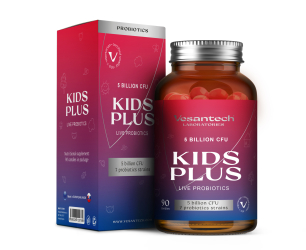
Fruit-based probiotics for children to support immunity and balance the gut microbiome.
And when is the combination most effective?
Use them together (or alternately) when: the child has recovered from a severe infection or long-term antibiotic use, has a weakened immune system, and also needs to improve digestion; you suspect an impaired microbiome but want to start safely; the child has difficulty tolerating probiotics → start with postbiotics, then switch to probiotics; you want to achieve both anti-inflammatory and regenerative effects simultaneously
Recommended usage protocol (ages 3+):
Phase 1 – Immune System Stabilization (1–2 weeks):
VESANTECH® KIDS (postbiotics): 1 lozenge daily → Activation of immune mechanisms, without burdening the gut
Phase 2 – Microbiota Restoration (2–4 weeks):
VESANTECH® KIDS PLUS (probiotics + prebiotics): 1 dose daily (Postbiotics may be continued 2–3 times a week—daily use is not necessary) → Supports the growth of beneficial strains, improves digestion
Phase 3 – Support and Maintenance (long-term):
Alternating between both products: During “virus season” or after a stressful period → 5 days of postbiotics, 2 days of probiotics, orevery other day (postbiotic/probiotic)
Frequently Asked Question:
Can I give my child both products on the same day?
➡️ Yes, but not at the same time.
Recommendation:
Morning: VESANTECH® KIDS (postbiotics) – to boost immunity
Afternoon or evening: VESANTECH® KIDS PLUS (probiotics) – to colonize and regenerate the gut while sleeping
Summary for Parents:
| Situation | Recommended Solution |
|---|---|
| The child is often sick | VESANTECH® KIDS (postbiotics) |
| Digestive problems, antibiotics | VESANTECH® KIDS PLUS (probiotics) |
| Combined issues | Start with KIDS, continue with KIDS PLUS |
| Prevention, seasonal support | Alternate between KIDS and KIDS PLUS |
The most valuable thing you can give your child is a healthy gut. With a healthy microbiome, your child becomes stronger, more resilient—and happier.

9. Why “just any probiotic” isn’t enough—and what to look for when choosing
In today’s world full of advertisements and superficial claims, it’s easy to believe that all “probiotics for children” are the same. But the reality is different.
The gut microbiota is a key biological system —it influences immunity, digestion, behavior, and a child’s overall development. That’s why it deserves purposeful, thoughtful support —not just a random pick off the shelf.
When choosing a high-quality product, look for:
✔️ Type of bacteria —which specific strains it contains
✔️ Quantity (CFU) —listed as an equivalent for postbiotics
✔️ Form and stability —does it need to be refrigerated? Can it withstand an acidic environment?
✔️ Presence of prebiotics and vitamins
✔️ Safety and tolerability – is it suitable for children with intolerances or allergies?
✔️ A form of administration that is pleasant for the child (candy, puree...)
Why do VESANTECH® products make sense?
They feature transparent ingredients, clinically validated strains, and carefully designed combinations . They take into account children’s age, sensitivity, and immune profile. They’re free of unnecessary additives: no sugar, lactose, gluten, or artificial ingredients. They can be administered alone or in synergistic combinations
And most importantly—they were developed based on scientific and therapeutic understanding, not marketing routines
You’re not just choosing a probiotic. You’re choosing a way to build your child’s health—a foundation they’ll feel for a lifetime.
VESANTECH® KIDS —when you’re looking for gentle yet effective support for immunity
VESANTECH® KIDS PLUS – when it’s time for gut restoration, growth, and balance
And when you know how to combine them wisely— you get the best of both worlds.
Photo by Olga Berezhna from Pixabay