SK
 CZ
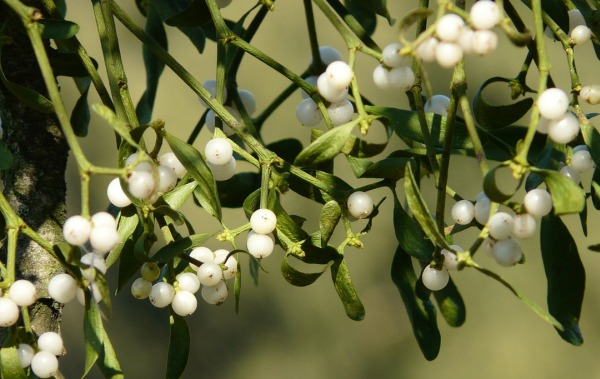
Slovak: Imelo biele, Latin: Viscum album, Czech: Jmelí
In this article, you will learn:
- The Origin of White Mistletoe
- Harvesting white mistletoe
- The medicinal properties of white mistletoe
- Poisonous parts of white mistletoe
- White mistletoe tea
- White Mistletoe and Tinctures
- White Mistletoe in Recipes
The Origin of White Mistletoe
Mistletoe has been used since ancient times in mythology and various rituals because it was believed to possess miraculous powers. This belief in the magical power of mistletoe on the Christmas table has endured for centuries. On New Year’s Day, Celtic priests would cut mistletoe sprigs with a golden sickle, wishing for love and happiness. That is why, even today, mistletoe can be found in nearly every home during the Christmas holidays. It symbolizes the desire for happiness for the entire family. Another well-known tradition is the Christmas kiss exchanged by lovers under a sprig of mistletoe so that their love and happiness will last the whole year.
Mistletoe’s remarkable medicinal properties have been recognized throughout the history of herbal medicine.
Few plants are shrouded in as many superstitions and myths as mistletoe. It was used by the ancient Celts, the Greeks, and even medieval healers. It has been used as a remedy right up to the present day.
The name “mistletoe” comes from Latin—“viscum” means “glue.” It has tiny white berries that are sticky to the touch. In order to attach itself to its host, it must remain there long enough to grow special roots.
As a plant parasite, it feeds on trees and draws life-giving sap from them. Although it is commonly found in the wild, it is usually high up and out of reach, so it is harvested from fallen trees at logging sites.
White mistletoe is an evergreen semi-parasitic shrub that grows on both coniferous and deciduous trees, except for oaks.
A stem (30–50 cm) grows from the tree branches and typically branches out in a forked pattern. The twigs are knotty, brittle, and terminated by two leaves. Each year, a new segment grows, often forming very bushy clumps.
The leaves grow at the tips of the twigs, always in pairs opposite each other; they are sessile, oblong-ovate, leathery, entire-margined, evergreen, with a yellow-green blade (semi-parasitic).

Mistletoe is a dioecious, insect-pollinated plant with clusters of sessile flowers. The pistillate flowers, which grow in groups of 2–4 at the tips or in the axils of the twigs, have inconspicuous, yellow-green petals and a inferior ovary with a disc-shaped stigma. The staminate flowers are larger, with a four-part tubular perianth and four stamens.
Harvesting White Mistletoe
The fruit is a round, single-seeded, translucent, false berry that is white or pale yellow in color, with a slimy, sticky pulp.
It blooms in March and April and ripens in November and December. The shoots are harvested (November–February), and the fruits are rarely harvested as well. The fruits are used for technical purposes (as glue for catching flies, birds, etc.).
Medicinal Effects of White Mistletoe
The main active compounds in mistletoe are the polypeptide viscotoxin, choline and acetylcholine, oleanolic acid, resin, starch, silica, vitamin C, and, in the berries, viscin and others. Currently, mistletoe growing on spruce trees is receiving a great deal of attention, particularly viscotoxin, which is believed to have, among other things, anticancer effects.
Its main therapeutic effect is the regulation of blood pressure, which it achieves by softening and removing calcium deposits in the vascular system, thereby preventing heart attacks and strokes. It is also effective in treating stomach cancer, epilepsy, thyroid disorders, and female and male infertility.
A heart attack usually gives warning signs several days in advance.
If you notice the following symptoms, see a doctor immediately: fatigue and weakness, sweating, difficulty breathing, shortness of breath, a feeling of tightness, anxiety, chills, and dull, severe pain in the chest radiating to the left shoulder. It is one of the most common causes of death. The underlying cause is almost always the same: a blood clot in a coronary artery affected by atherosclerosis. Blood flow and oxygen supply to the affected area are insufficient. At the first sign of trouble, it is essential to go to the hospital immediately or, preferably, call an emergency medical service. In the event of a heart attack, it is recommended to rub hawthorn ointment into the skin over the heart area.
It is important to eat plenty of fruits and vegetables, as well as garlic, and to stop drinking alcohol and smoking. Get plenty of exercise in the fresh air; under no circumstances should you exceed the recommended doses. It is best taken in the form of drops.
Its preventive anti-heart attack effects should be used repeatedly, but only in small doses, as mistletoe can be dangerous if overdosed.
Mistletoe is a mildly toxic plant, so it should be used with great caution.

Poisonous Parts of White Mistletoe
It is a mildly toxic plant. Mistletoe growing on poplar trees is the most toxic; therefore, it is not harvested from these trees for medicinal purposes. Mistletoe from hawthorn or apple trees is most suitable . For medicinal purposes, the leaves are primarily used, as they contain the least amount of toxic substances. Side effects of white mistletoe include abdominal pain or diarrhea. Some people may also experience a fever, a drop in blood pressure, irregular heartbeat, and hallucinations. In this case, reduce the dosage or stop taking mistletoe altogether. Mistletoe should not be used during pregnancy or while breastfeeding.
White Mistletoe Tea
You can also purchase mistletoe in the form of tea— White Mistletoe (herb)—at our herbal shops and online store. It significantly lowers blood pressure and alleviates the sensation of blood rushing to the head, especially during menopause. It regulates bile secretion into the intestines and influences pancreatic function. It has anti-rheumatic properties, suppresses pathologically elevated thyroid activity, and helps treat certain symptoms of hay fever. For varicose veins and leg ulcers, washing the affected areas or taking foot baths may be recommended. Mistletoe is beneficial in treating bedwetting in adults and white vaginal discharge.
Other herbal teas containing mistletoe include: Metabolik—regulates metabolic disorders and lowers cholesterol; Anticholest— for elevated blood cholesterol; Hypertonik—lowers blood pressure and improves the resilience of arterial walls; and Hemopur—recommended as a dietary supplement for hemorrhoids. Cievny —has a beneficial effect on vascular inflammation.
White Mistletoe and Tinctures
You can also purchase mistletoe in the form of a gemmotherapy tincture. White Mistletoe T13 —normalizes blood pressure, relieves headaches, dizziness, and hot flashes during menopause. It reduces the buildup of unwanted substances in blood vessels and calms heart activity. It supports pancreatic and thyroid function. It helps alleviate the symptoms of varicose veins and promotes healthy joint function.
It is also included in the following gemmotherapy regimens: Regimen K06 —An herbal supplement to harmonize the body during menopausal difficulties. This regimen supports hormonal activity in the body and helps alleviate unpleasant menopausal symptoms and discomforts, such as hot flashes and sweating.
Treatments K31 and K31A — herbal supplements for blood pressure issues. They have a beneficial effect on the vascular system, clear arteries of deposits, and help normalize blood pressure.
To wrap things up, here’s a recipe for mistletoe tincture
Place about 150 g of fresh mistletoe in a jar with a tight-fitting lid and pour in ½ liter of alcohol so that the mistletoe is completely submerged. Let it steep in a dark place for about 8 weeks, shaking occasionally. Then strain it, squeeze out the remaining liquid, let it settle in a dark place for a few more days, and carefully decant it. Take 15–20 drops 2 to 3 times a day.
We’ll conclude today’s short article with a well-known saying:
“Don’t fear a heart attack if you believe in mistletoe.”
Prepared by: Mgr. Dagmar Machničová, editorial staff at www.zdravysvet.sk
References:
Marta Velgosová, Štefan Velgos—Our Medicinal Plants; Dionýz Dugas—500 Best Recipes of Folk Medicine; Aurélia Dugasová, Dionýz Dugas—Grandma’s Herbs.
Photos: Fotolia, Pixabay