SK
 CZ

In this article, we’ll explain in a factual manner—and without unnecessary fear-mongering—how the prostate works, what happens to it as we age, which symptoms shouldn’t be ignored, and what research actually says about the herbs and nutrients associated with the prostate. The goal is for you to be able to distinguish between evidence-based information and marketing claims.
Why It’s Worth Talking About the Prostate Right Now
Data from the National Center for Health Information speaks for itself. The incidence of prostate cancer in Slovakia has risen from 74 confirmed cases per 100,000 men in 1996 to an estimated 165 cases per 100,000 in 2024—more than double (NCZI).

Graph: Incidence of prostate cancer in Slovakia: 1996 vs. 2024
Prostate cancer is among the most common malignant tumors in Slovak men (NCZI). This trend is not limited to Slovakia. In Europe, approximately 462,000 new cases are diagnosed annually, and globally, prostate cancer is the fourth most common cancer overall (IARC GLOBOCAN). Furthermore, an expert panel from The Lancet estimates that the number of new cases worldwide will rise from 1.4 million in 2020 to 2.9 million by 2040 (The Lancet).
One factor in particular is driving this growth: an aging population. The number of older men is increasing, and since the incidence of prostate disease rises sharply with age, the actual number of people affected is growing. That is why it makes sense to take care of your prostate before it starts causing problems.
How the Prostate Works and How It Changes with Age
The prostate is a walnut-sized gland located below the bladder and surrounding the beginning of the urethra. It produces part of the fluid that makes up semen and plays a role in male fertility.
Its location is key. Since the urethra passes directly through the prostate, any enlargement of the prostate can press on the urethra and make urination difficult. That is why prostate problems most often manifest during urination.
The prostate naturally grows with age. In many men over 50, it begins to enlarge and may gradually press on the urethra. This process is measured using the IPSS (International Prostate Symptom Score) questionnaire, which assesses the severity of urinary symptoms. Most reputable clinical studies, which will be discussed below, also use this same questionnaire.
Three Types of Problems—and Why a “Prostate Problem” Isn’t Automatically Cancer
When a man hears that he has “a problem with his prostate,” he often fears the worst. In reality, there are three distinct categories of symptoms, and most of them are not related to cancer.
- Benign prostatic hyperplasia (BPH) is a noncancerous enlargement of the prostate. It is the most common cause of urinary problems in older men, and its prevalence rises sharply with age, particularly among men between the ages of 60 and 90 (PMC). In Slovakia, the number of BPH cases rose from approximately 91,700 in 2000 to 135,000 in 2019, an increase of 47.6% (Global Burden of Disease). It is a benign condition—unpleasant, but not life-threatening.
- Prostatitis is an inflammation of the prostate. It can be acute or chronic, and in cases of chronic inflammation associated with pelvic pain syndrome, treatment tends to be protracted. It also affects younger men.
- Prostate cancer is a malignant tumor. This is the condition referred to in the statistics at the beginning. It is diagnosed by a urologist, among other things, by testing the level of PSA (prostate-specific antigen) in the blood. This is a purely medical matter that should be left to a doctor.
It’s important to make this distinction so you know that frequent nighttime urination doesn’t necessarily mean cancer. At the same time, however, it’s always a good idea to consult a doctor about any new symptoms to be sure.
Symptoms You Should Not Ignore
Prostate problems most often manifest during urination. Typical symptoms include:
- frequent urination, especially getting up repeatedly during the night (nocturia),
- a weak or interrupted urine stream,
- a feeling that the bladder is not completely empty,
- a sudden, difficult-to-control urge to urinate,
- delayed onset of urination or dribbling after urination.
In most cases, these symptoms are associated with benign prostate enlargement. Nevertheless, a simple rule applies: if you notice blood in your urine or ejaculate, pain, a fever, or a sudden, significant worsening of symptoms, see a doctor without delay.
Experts recommend that men over 50 (and those with a family history, as early as 40) consult a doctor about a PSA test. A preventive screening can detect potential problems early, when treatment is simplest.
Risk Factors and What You Can Control
We cannot influence some risk factors, but we can influence others. Among those beyond our control are:
- age— by far the strongest factor,
- family history and genetics— the risk increases if the disease has occurred in a father or brother,
- ethnic background.
The good news is that we have control over our lifestyle, and this is where prevention makes a difference. Obesity and metabolic syndrome, a lack of physical activity, and a diet low in vegetables are associated with a higher risk of prostate disease. Therefore, sensible prevention includes:
- maintaining a healthy body weight,
- regular physical activity,
- a varied diet with plenty of vegetables and healthy fats,
- moderation in alcohol consumption.
These are steps that benefit not only the prostate but a man’s overall health. No single food or supplement is a miracle cure—it comes down to a long-term set of habits.
Herbs and Nutrients—What the Research Really Says
There are many claims circulating about natural prostate support. Let’s take a sober look at the most well-known substances—what clinical studies say about them and where caution is needed. It’s important to know that dietary supplements are not medications and do not replace medical care. They can only serve as a complementary part of maintaining urinary tract health.
An Overview of the Evidence for Herbs and Nutrients in Prostate Health
Pumpkin and phytosterols
Pumpkin seeds and oil are among the best-known natural options for urinary difficulties. The largest clinical study, GRANU, included 1,431 men and lasted 12 months. Men taking pumpkin achieved a slightly better response than the placebo group (58.5% vs. 47.3%), although the study’s predefined primary endpoint was not met (GRANU). There is thus a suggestion that symptoms may be alleviated, but the evidence is not conclusive. The effect is likely due to phytosterols—plant compounds found naturally in abundance in pumpkin.
Beta-sitosterol
Beta-sitosterol is a specific phytosterol and is among the better-studied plant compounds. Reviews of clinical studies suggest that it can improve urinary symptoms and urine flow in the short term. However, it does not reduce the size of the prostate itself—it acts on the symptoms, not on its size (Cochrane).
Stinging Nettle and Pygeum
The root of stinging nettle (Urtica dioica) has traditionally been used in Europe for urinary difficulties, and several clinical studies have reported an improvement in symptoms compared to placebo, often in combination with other herbs (PMC). Similarly, according to a review of studies, pygeum (Prunus africana) bark extract mildly alleviates urinary symptoms and nocturia, although these studies are mostly older and smaller in scale (Cochrane).
Pollen Extract and Willow Herb
A standardized extract of rye pollen has been studied for benign prostatic hyperplasia as well as chronic inflammation, and some studies have reported a slight improvement in nocturia (PubMed). Small-flowered willowherb is a traditional herb of Central Europe, known to men primarily as a tea to support urinary tract health.
Saw palmetto—it depends on the form and combination
Saw palmetto (Serenoa repens) is perhaps the best-selling “prostate” herb in the world, and it is precisely with this herb that it becomes most apparent just how much the details matter. A comprehensive review of 32 randomized studies involving 5,666 men, as well as the large STEP and CAMUS studies, found that saw palmetto taken alone does not relieve symptoms any better than a placebo (Cochrane). However, this applies to monotherapy and common, non-standardized preparations.
Zinc and Selenium—Why More Isn’t Better
Zinc is an important mineral for men’s health, and in Europe it has approved health claims, for example, for normal fertility and maintaining normal blood testosterone levels (EU Register). However, there is no evidence that high doses of zinc specifically protect the prostate.
Even greater caution is warranted with selenium. The large SELECT study, involving more than 35,000 men, found that neither selenium nor vitamin E reduced the risk of prostate cancer. Vitamin E actually slightly increased the risk, and selenium provided no benefit (National Cancer Institute). The message is simple: with these substances, more is not necessarily better. It makes sense to supplement them only in reasonable, physiological doses.
Lycopene, Vitamin D, and Omega-3
Lycopene, a pigment found in tomatoes, has long been studied in relation to the prostate, but the evidence is mixed, and there is no proven preventive effect. Vitamin D and omega-3 fatty acids are beneficial for men’s overall health and inflammatory balance, but no direct effect on the prostate has been demonstrated. We should therefore view them as support for overall well-being, not as a targeted “prostate treatment.”

Summary of the Evidence
Review studies agree that herbal support is supplementary and does not replace urological care (review of phytotherapy). The most promising results for urinary symptoms currently come from pumpkin, beta-sitosterol, and stinging nettle root. With saw palmetto, it depends on the form—stand-alone, non-standardized preparations have disappointed in rigorous studies, while standardized extracts combined with stinging nettle have performed better. As for selenium, it’s important not to overdo the dosage.
What makes sense to include
If you want to support prostate health sensibly, it makes sense to combine three things: a healthy lifestyle, regular preventive checkups with a doctor, and, if appropriate, supplements containing ingredients backed by at least promising evidence. Below, we’ve selected products from our lineup that fit this approach. These are dietary supplements and herbal products, not medications.
- Vesantech Prostate Probiotics —a complex of probiotics and herbal extracts formulated specifically for men over 35. The package contains 120 capsules with a dual formula (probiotics and herbal extracts).
- Styrian Pumpkin Seeds and Styrian Pumpkin Oil —a natural source of phytosterols, substances with the most promising evidence for alleviating urinary symptoms.
- Willow Herb Herbal Tea for the Prostate —pre-portioned tea containing small-flowered willow herb, goldenrod, heather, and marjoram. A simple daily ritual to support the urinary tract.
- K03 Prostate Treatment —an herbal treatment made from tinctures (including narrow-leaved marsh marigold and poplar), traditionally focused on the urinary tract and prostate.
- Prostavin BIO —an herbal elixir based on St. Hildegard’s traditional recipe. Due to its alcohol content, use it in moderation and according to the recommended dosage.
- Liposomal Vitamin C + Zinc + D3 + Se – a combination of zinc, selenium, and vitamins D3 and C in an easily absorbable liposomal form. It supports men’s health in reasonable doses—in keeping with the principle that “more is not always better” when it comes to these minerals.
- Krill oil or omega-3 fish oil —a source of omega-3 fatty acids to support inflammatory balance and overall health.
- Medicinal mushrooms —reishi or cordyceps—as a complementary wellness element for men seeking comprehensive support.
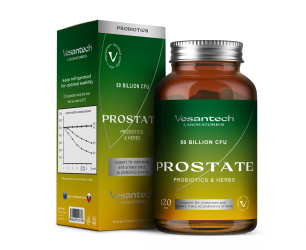
A premium probiotic complex with herbs for prostate and urinary tract health.

Frequently Asked Questions About the Prostate
Does pumpkin seed oil help with prostate issues?
Pumpkin is one of the most extensively studied plants for urinary symptoms, and the largest study reported slightly better results compared to a placebo. The evidence is not conclusive, but among herbal options, pumpkin is among those with the most promising results.
What are the first symptoms of an enlarged prostate?
The most common symptoms are frequent urination, repeatedly getting up at night, a weak urine stream, and a feeling of incomplete bladder emptying. These symptoms are usually associated with benign enlargement, but it’s worth consulting a doctor about any new difficulties.
Does coffee affect the prostate?
Caffeine has a diuretic effect and can increase the urge to urinate, especially in the evening. If you are sensitive to these symptoms, limiting your intake of coffee and other fluids late in the day can help. However, a direct link between coffee and the development of prostate conditions has not been conclusively proven.
Do herbs shrink the prostate?
No. Even the most thoroughly studied herbal remedies do not shrink the prostate—at best, they alleviate urinary symptoms. Shrinking the prostate is a matter for medical treatment, which is determined by a doctor.
When should you get a PSA test?
Men are generally advised to consult a doctor about a PSA test after age 50, or sooner if there is a family history of prostate disease. The specific course of action is always determined by the doctor.
The prostate is an organ worth taking care of before it starts causing problems. Rising numbers in Slovakia and across Europe are not a cause for panic, but they do warrant attention. The foundation remains a healthy lifestyle and regular preventive checkups with a doctor. Herbs and nutrients can be a sensible supplement—as long as we approach them with a level head, know which ones have at least promising evidence, and don’t expect miracles from them.
If you are experiencing urinary problems or have any concerns, your first step should be to see a doctor. Dietary supplements are not a substitute for medical care, and this article is for informational purposes only; it does not replace a professional consultation.
Sources
- National Center for Health Information (NCZI): https://www.nczisk.sk/Aktuality/Pages/Vyskyt-zhubnych-nadorov-na-Slovensku-Pacienti-ziju-dlhsie-no-pribuda-pripadov-rakoviny-prsnika-a-prostaty.aspx
- National Cancer Registry of the Slovak Republic: https://www.noisk.sk/narodny-onkologicky-register/epidemiologia-nadorovych-ochoreni-na-slovensku
- IARC GLOBOCAN 2024 — Prostate: https://gco.iarc.who.int/media/globocan/factsheets/cancers/27-prostate-fact-sheet.pdf
- The Lancet Commission on Prostate Cancer (2024): https://www.thelancet.com/journals/lancet/article/PIIS0140-6736(24)00651-2/fulltext
- Global Burden of Disease — BPH: https://pmc.ncbi.nlm.nih.gov/articles/PMC9640930/
- BPH and Age — Overview: https://pmc.ncbi.nlm.nih.gov/articles/PMC11376082/
- EAU — Non-neurogenic Male LUTS (2024): https://d56bochluxqnz.cloudfront.net/documents/full-guideline/EAU-Guidelines-on-Non-Neurogenic-Male-LUTS-2024.pdf
- Overview of Phytotherapy for BPH: https://pmc.ncbi.nlm.nih.gov/articles/PMC10003922/
- Pumpkin — GRANU study: https://pubmed.ncbi.nlm.nih.gov/25196580/
- Beta-sitosterol — Cochrane: https://pmc.ncbi.nlm.nih.gov/articles/PMC8407049/
- Stinging nettle — randomized study: https://pmc.ncbi.nlm.nih.gov/articles/PMC3589769/
- Pygeum — Cochrane: https://www.cochrane.org/evidence/CD001044_extracts-african-prune-tree-pygeum-africanum-may-be-able-help-relieve-urinary-symptoms-caused
- Pollen extract (Cernilton): https://pubmed.ncbi.nlm.nih.gov/10792162/
- Saw palmetto (monotherapy) — Cochrane: https://pmc.ncbi.nlm.nih.gov/articles/PMC7084061/
- Saw palmetto + stinging nettle (WS 1541 / Prostagutt combination): https://journals.sagepub.com/doi/10.1177/1756287219879533
- Selenium and vitamin E — the SELECT study: https://www.cancer.gov/types/prostate/research/select-trial-results-qa
- EU Register of Health Claims: https://ec.europa.eu/food/food-feed-portal/backend/claims/files/euregister.pdf
Images used: Perplexity AI
Author, Martin Kolčák, Zdravý svet