SK
 CZ
© BONSAJ A ČAJ Magazine
Article authors:
RNDr. Vladimír Ondejčík, RNDr. Alena Ondejčíková
Bonsai Center Nitra
Contemporary global medicine is increasingly turning its attention to the riches of tropical rainforests. Within the vast array of unique plant species and their medicinal uses by indigenous peoples, it is finding cures for many modern diseases of civilization. Among these rediscovered medicinal trees is the legendary Inca tree, the Lapacho (lapačo). According to ancient records, the bark of the Lapacho tree was used to treat even the ancient Inca rulers long before the arrival of the Spaniards in the New World.
LAPACHO TEA IN THE SPOTLIGHT
Lapacho (lapačo) contains a wide range of compounds that can significantly strengthen the body’s immune system and effectively help with a full spectrum of diseases—even the most serious ones.
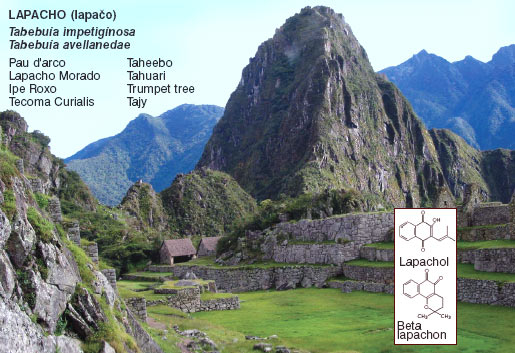
The renowned William Koch also conducted research on the oxidation-reduction potential of Lapacho, and surprisingly, as early as 1864, E. Paterno and scientists at Bayer Laboratories isolated and identified the active compound lapachol. It is precisely this component that exhibits high biological activity in the treatment of tumors. The catalytic conversion of lapachol to betalapachone further enhances Lapacho’s effect. In 1896, S. C. Hooker determined the chemical structure of lapachol, and L. F. Fieser synthesized this substance as early as 1927. Scientific research into the health benefits of Lapacho has been conducted since those early days, and today, published research on the effects of Lapacho extracts on the human body fills entire libraries. Just the impressive stack of papers with scientific and medical studies on the effects of Lapacho lying on my desk would be enough to fill a thick volume.
THE TREE OF THE ANCIENT INCAS
The use of Lapacho is also recommended by world-renowned physicians, who, together with a number of chemists, have ranked Lapacho among the foremost medicinal plants on our planet. Although tea made from this unique tree did not reach Western European markets until 1991, its medicinal properties were already known and utilized by the ancient Incas, and to this day by their descendants—the Callawaya Indians living high in the Andes—as well as members of the Quechua and Aymara tribes. It was they who called their divine tree “Taheebo.”
TIP: Discover other treasures of nature! Read about how you can use Tribulus terrestris.
LAPACHO: THE TREE OF STRENGTH AND ENERGY
Tajy—that’s what the indigenous peoples of the Tupi-Guarani and Nambo tribes called this miraculous tree. Tajy meant “to have great energy and vitality.” This fantastic medicinal tree grows primarily in the dense Amazon rainforests of Brazil and in the warm mountainous regions of South America, particularly in Argentina, Paraguay, and Bolivia.
It thrives in green areas rich in ozone, in clean air free of pollution, smog, and exhaust fumes.

LAPACHO AND THE VIKINGS
The medicinal properties of Lapacho were also utilized outside the rainforest regions and even outside tropical areas. Yugoslav scientist Vojislav Todorović discovered that the Vikings and Russians were also familiar with and used this tree. In fact , as early as 1800, Russian chemists were producing toothpaste containing Lapacho extracts, which had a proven effect in preventing tooth decay.
BEAUTIFUL FLOWERS
This is a very interesting and beautifully flowering tree. Tabebuia impetiginosa or Tabebuia avellanada grows to a height of 30 m, lives up to 700 years, and has unusually hard wood, which the ancient Incas used to make bows. However, they also recognized the immense medicinal value of the inner layer of its bark. They called it the “Divine Tree.” Or simply Red Lapacho, thanks to its magnificent reddish-purple funnel-shaped flowers and reddish-brown bark.
HEALING OXYGEN AND BLOOD
The cambium of this amazing tree binds a great deal of oxygen, which helps destroy viruses, bacteria, fungi, molds, and protozoa found in the human body, while also supporting the production of red blood cells because it contains a high amount of iron. Proper blood formation and oxygen transport in the body are essential for our health.
Lapacho increases both the hemoglobin content and the number of red blood cells, thereby increasing the blood’s capacity to transport oxygen. Lapacho bark contains a high amount of iron, which the tree can transfer to human blood.
IN THE FIGHT AGAINST CANCER
Lapacho is also used in the treatment of diabetes because it slows glucose absorption in the human intestines while promoting the utilization of long-chain carbohydrates and fats in the body, thereby contributing to weight loss and a reduced sense of hunger.
It cleanses the liver, removes toxins and toxic metabolites from the body, strengthens the body, inhibits tumor growth, and combats leukemia, as it significantly promotes red blood cell production in the bone marrow and is considered a blood stimulant. Scientific research holds great promise for Lapacho, particularly in the treatment of cancer. In many patients, it has demonstrated the ability to inhibit tumor growth.
LAPACHO IS A POWERFUL ANTIOXIDANT
Lapacho is a very powerful antioxidant and prevents the formation and occurrence of free radicals. It alleviates headaches and nervousness and is even used to treat malaria.
Its effect on skin problems is also significant. It treats various inflammations, eczema, psoriasis, wounds, and festering sores. It has anti-inflammatory properties and helps regenerate blood vessels and treat varicose veins. We recommend regularly applying warm Lapacho tea compresses to affected areas or enjoying therapeutic baths.
Excellent results are also achieved by regularly rinsing the mouth with this pleasant tea. This reduces the harmful effects of amalgam on the body as well as the risk of infection and periodontal disease.

One scientist studying the effects of Lapacho remarked with admiration that Lapacho seems to cure just about everything.
STIMULATES THE IMMUNE SYSTEM
However, the main effect of Lapacho tea remains its ability to activate the body’s own defense system, thereby boosting immunity, eliminating various unwanted parasites and pathogens, and helping to combat cancer, diabetes, and an unhealthy internal environment. The tea is also suitable for children. No side effects have been demonstrated to date.
PROPER PREPARATION OF THE TEA
We recommend drinking Lapacho tea in 4- to 6-week therapeutic and cleansing courses. Proper preparation of the tea is important. Since it consists of grated tree bark, it is best to first boil a heaping teaspoon of tea in 3 dl of water for 5–10 minutes and then let it steep for another 10–15 minutes so that all the active ingredients are released into the solution. For therapeutic purposes , drink the tea warm, preferably unsweetened. Enjoy 3 cups a day between meals.
We recommend: Lapacho Matto Grosso
For added flavor and enjoyment, you can also prepare some very interesting recipes with Lapacho tea by adding honey, fruit—such as chopped dried apples or orange peel and juice—or even aromatic spices.
The treatment can be repeated after one month. For preventive purposes, one cup a day is sufficient, or at least occasionally, as desired.

LAPACHO AND CATUABA
The effectiveness of Lapacho tea is enhanced when mixed with another tea from the Amazon rainforest. It is called Catuaba and is a well-known aphrodisiac and a tea that boosts energy and relieves fatigue. Grated Catuaba bark is mixed with Lapacho bark in a 1:1 ratio, and the tea is prepared the same way as pure Lapacho. This combination is beneficial because it enhances the effectiveness of both plants.
Would you like to try this magical blend? We recommend Lapacho Afrodita tea!
LAPACHO COMPRESSES
To prepare Lapacho tea compresses, follow the same method as for making an infusion, but use 2 heaping teaspoons of tea per 3 dl of water; you can also apply the steeped bark, wrapped in clean gauze.
BEWARE OF METALS
Caution: Do not prepare or store the tea in aluminum or tin containers. Inert materials such as glass or high-quality glazed ceramics are more suitable.