SK
 CZ
What you’ll learn in the article about the round-headed toad:
- The Round-headed Witch in a Nutshell
- Distribution of the Round-headed Witch
- Effects of the round-headed echinops
Slovak: Round-headedEchinops , Latin: Echinops sphaerocephalus, Czech: Round-headed White Thistle
The Round-headed Echinops at a Glance
The round-headed thistle is native to the steppe and semi-desert regions of Central Asia, the Ciscaucasus, Asia Minor, and southern Europe. It has spread secondarily from the Mediterranean to nearly all of Europe. It grows as far as the Baltic States, Scandinavia, the British Isles, and North America.
This plant was originally planted in ornamental gardens for its striking spherical inflorescence. As early as 1871, it was recorded in the wild and has gradually become a species that continues to spread, particularly in warmer regions.
Distribution of the Round-headed Witch
It most often prefers sunny habitats with slightly alkaline loamy to sandy soil that is well-supplied with nutrients.
In Slovakia and the Czech Republic, it occurs sporadically throughout the entire territory. You can find it around railroad and road embankments, in dry ditches along roads or on riverbanks, in abandoned orchards and vineyards, in neglected fields, in quarries, and in sandy soils.
The sow thistle is a perennial plant with a stiff, straight stem and lyre-shaped leaves similar to those of a dandelion. It differs from dandelions in its stiffness, but above all in its fine spines. The relatively large leaves are mostly irregular in shape, basal, and typically grow in a rosette. They are rarely entire; their margins are serrated and their tips are spiny. They are usually hairy, as is the stem.
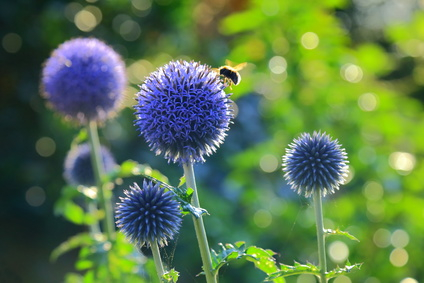
The white, blue, or purple spherical inflorescence consists of numerous regularly arranged single-flowered clusters with three-row bracts and bracts of varying shapes and sizes. The five-parted hermaphroditic flowers are tubular in shape. The sepals are tiny, and the petals are fused into a tube. The flower has five stamens with grayish anthers, and from the inferior ovary—composed of two carpels—protrudes a style with a deeply notched stigma that extends beyond the corolla. Deep within the flowers, which are pollinated by insects, are nectaries (nectar-producing structures).

The fruit is an achene dispersed by wind, animals, and human activity.
Under natural conditions, its seeds are capable of germinating immediately after ripening or as late as spring following winter stratification. It also reproduces via runners from buds on the root crown.
The main component of Echinops is the alkaloid echinopsin, followed by fatty oils, bitter compounds, and traces of glycosides.
It blooms from June to August.
A related ornamental plant is the blue globe thistle (Echinops rifro L.), native to southern Europe. The globe thistle is not only visually attractive but also very useful as a nectar source. The seeds of both the round-headed globe thistle and the blue globe thistle have equivalent medicinal properties and the same chemical composition.
Effects of Globe Echinops
Globular echinops supports the activity of the nervous and cerebral centers. It is used to treat muscle atrophy, promotes the restoration of muscle mobility, and soothes irritation and pain of nervous origin. It treats peripheral paralysis, nerve inflammation, various types of neuralgia, and disorders of nerve impulse conduction. It is used in cases of paralysis, severe injuries, and inflammation of the spinal cord. It supports recovery after severe injuries and strokes.
In small doses, it has a beneficial effect on cardiac function and stimulates the heart muscle.
Its cardiotonic effect initially causes a slight increase in blood pressure, followed by a relatively significant decrease.
A related species, the Daurian echinops (Echinops dhaurica), is used in traditional Chinese medicine as a hemostatic agent. Preparations made from all echinops species can also be used for baths and to wash inflamed skin. A professionally prepared solution of echinopsin nitrate is used for intramuscular injections; a tincture made from freshly ground seeds is also commonly used.
You can purchase it in our herbal shops and online store in the form of a gemmotherapy tincture called Globe Thistle T1, made from the mature plant, or P52, made from the plant’s buds.
It is also part of the exceptional K07 gemmotherapy regimen—a treatment used for nervous system disorders. It supports nervous system function.
It aids in recovery from nervous disorders and injuries, contributes to the revitalization of nervous tissue, improves blood circulation, and calms the body.
Keep in mind that the herb needs to be taken over a longer period for the affected nerve center to regenerate; this also applies to the treatment of depression. This is simply a reminder based on our experience at our herbal shops. Many people think that after drinking a cup of tea or taking a single dose of tincture, their problems will disappear immediately. Yet with many neurodegenerative diseases, simply slowing or halting the progression of the disease is already a victory.
In closing, here’s another quote:
“God created medicinal plants from the earth, and a wise person does not reject them.”
Natural herbal treatment has its benefits. You ask, what are they?
- The treatment can be applied to any illness and in any condition.
- We can use herbs even when we don’t know what the illness is.
- We can use them even when more aggressive treatments aren’t an option.
- Herbs contain substances essential for the body, such as vitamins, trace elements, hormones, and enzymes.
- It is the best form of prevention, but we must not forget that it takes longer to take effect.
We can only help those who are seeking help. Those who seek real help think, explore, and discover—and they also turn to nature. That the path to health through natural remedies is the right one, and that cleansing the body with natural remedies is the path to maintaining health and longevity—this is evident in the life of Dr. Walker, an American physician who practiced natural medicine. Using various types of vegetable juices that cleanse and heal the body, along with colon cleansing, he cured many diseases that conventional medicine had “given up on.” He himself was also a living example of this effective treatment. He lived to be 116 years old, and at the age of 113, he wrote his final book on healing with these methods.
What do you think? Is our natural world worth exploring and discovering its “treasures”?!
Mgr. Dagmar Machničová, Editorial Staff, www.zdravysvet.sk
References: Mgr. Jarmila Podhorná, Buds Heal.
Photo: Fotolia