SK
 CZ
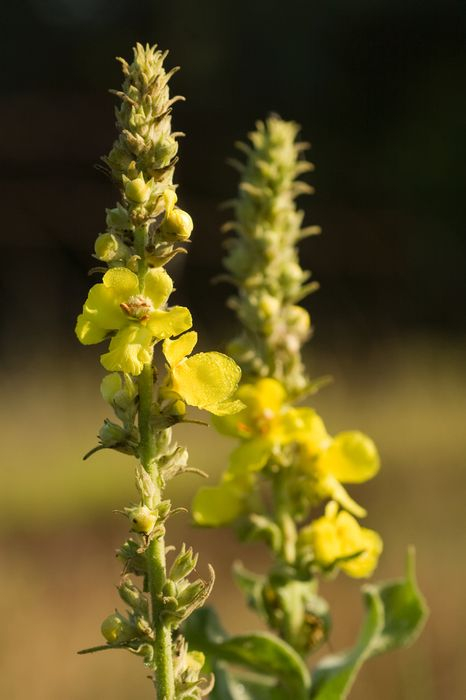
Slovak: Large-floweredmullein , Latin: Verbascum densiflorum, Czech: Large-flowered mullein, common name: king’s candle
Mullein has long been used for various purposes. In Roman times, figs were wrapped in its leaves to keep them fresh for a long time. The flowers were used to make candle wicks. Older women used their yellow color to dye their hair.
Where can we find this herb?
Goldenrod can be found on sunny, rocky slopes, in clearings, along roadsides, and on railroad embankments, but it is also increasingly adorning our gardens.
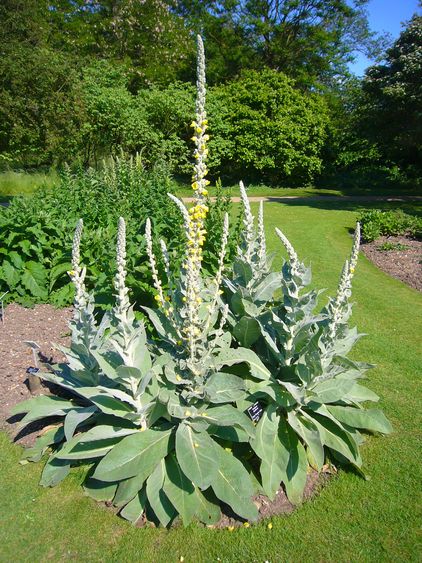
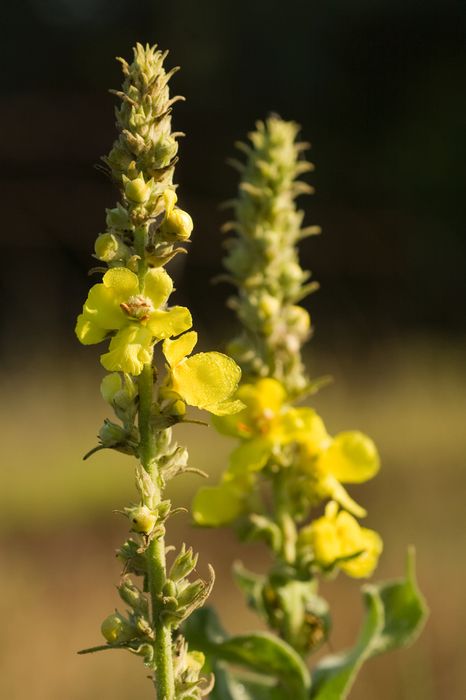
It is a robust biennial herb. In the first year, a rosette of basal leaves develops, and in the second year, a slightly angular, densely gray-hairy, straight, hollow stem grows up to 200 cm tall. Sometimes it is slightly branched toward the top. The rosette leaves are oblong to obovate, pointed, and coarsely lobed. The stem leaves are sessile, alternate, ovate, pointed, and coarsely lobed. The stem leaves are sessile, alternate, ovate, pointed, tomentose, and tapering toward the next leaf. The flowers (up to 5 cm in size) are arranged in clusters (of 2–5), forming a terminal raceme 30–80 cm tall (sometimes branched at the base). The flowers have 5 felted sepals, a funnel-shaped, disc-like, felted, lemon-yellow corolla of five petals, and 5 stamens with orange anthers. The stamens are attached to the corolla (the two lower ones are longer and glabrous, and the three upper ones are shorter with white, woolly filaments. The orange anthers are attached perpendicular to the filaments). The entire stem is grayish and hairy; the leaves and calyx are white and felt-like. The hairs are tree-like and branched. The fruit is a multi-seeded, two-chambered dehiscent capsule.
It blooms from June to August. The fragrant flowers bloom gradually each day, practically throughout the entire summer.
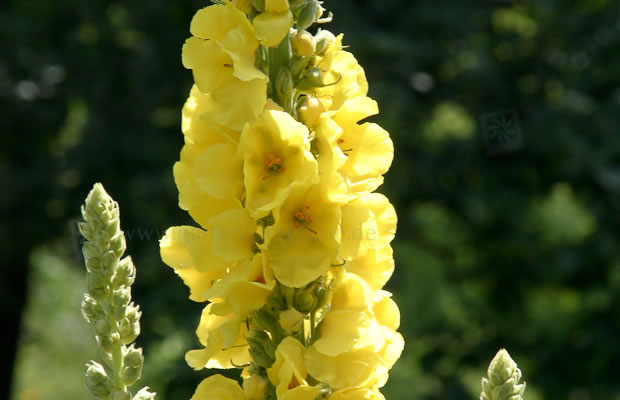
The flowers, leaves, and, rarely, the stems and roots are harvested.
Since the flowers open gradually, we harvest them daily, preferably on a sunny day around noon.
Its high content of mucilaginous substances makes wild yarrow ideal for treating the bronchi and lungs. It loosens mucus and clears the bronchi. It is excellent for coughs and hoarseness, treats laryngitis, and soothes irritation of the upper respiratory tract. Externally, large fresh mullein leaves can be applied to various painful areas and wounds. Mullein is used for leg ulcers, hemorrhoids, slow-healing wounds, neuralgic disorders, and pain in the facial nerves and ears. A strong decoction can be used as a gargle. Tea made from the flowers helps regulate light menstrual flow. The juice from fresh leaves is used as an emollient for swellings and ulcers.
Mullein has no adverse effects and can be used on its own.
It is also beneficial for bees, providing them with nectar and pollen.
In our herbal shops and online store, you can purchase mullein in the form of teas, specifically: Large-flowered Mullein — loose-leaf tea. This tea is used for inflammatory respiratory conditions, the flu, and the common cold. It increases mucus secretion in the respiratory tract, facilitates expectoration, and forms a protective coating on the mucous membranes, thereby preventing irritation and inflammation.
Additionally, Divozel offers the fruit teas “Splnené sny” and “Lapacho Sladké Vianoce.” The Lapacho tree is a medicinal plant that grows primarily in the dense Amazon rainforests of Brazil and the warm mountainous regions of South America, particularly in Argentina, Paraguay, and Bolivia. Lapacho tea contains a wide range of compounds that can significantly strengthen the body’s immune system and effectively aid in treating a full spectrum of illnesses, including even the most serious ones. The healing power of Lapacho tea is useful in the treatment of cancer; it also helps combat viruses, bacteria, fungi, and molds, while promoting the production of red blood cells. Lapacho tea is rich in iron, which it can transfer to the blood. Lapacho tea is also used in the treatment of diabetes and as part of diets; it cleanses the liver, inhibits tumor growth, and combats leukemia. It is considered a blood stimulant.
You can purchase Divozel in herbal tea blends such as Bronchial Tea, Lung Tea, and Sea Buckthorn Tea from the Czech herbalist Valdemar Grešík. It is included in the Vital, Energy, Mauritius, Easy Breath, Picasso, Ginkgo Rose, and Children’s Tea—Cough and Bronchial blends.
You can also purchaseElecampane P54 in its most effective form: as a tincture. The extract from the plant’s buds influences the function of the thymus and spleen and helps combat certain allergies. It primarily treats respiratory problems, asthma, and inflammatory processes in the airways. It addresses bronchitis, pneumonia, allergies, asthma, and coughs.
We would like to highlight the Respiro T52 macerate—an excellent blend of the six best herbs for the respiratory tract: black elderberry, goldenseal, ribwort plantain, linden, calendula, and coltsfoot. It is an excellent aid for colds and the flu. It relieves spasms in the bronchi and bronchioles. It promotes expectoration and has antibacterial effects. It helps with cold-related illnesses—especially colds affecting the respiratory and urinary tracts, as well as coughs. It is also used for various inflammatory conditions in the ears and eyes. Overall, it treats coughs, bronchitis, and middle ear infections.
Echinacea flowers are used to make the excellent Echinacea Oil O6, which has anti-inflammatory and healing properties. It can be used as a compress for wounds and varicose ulcers. It is particularly suitable for ear and nasal infections, where inflammation is alleviated by flushing both sinuses.
The natural VK05 Respiratory Tract Bath is designed to improve and regenerate the respiratory system. It can alleviate respiratory problems, inflammatory conditions, asthma, and upper respiratory tract infections, as well as simply regenerate the respiratory tract and thereby strengthen the body overall.
Divozel also contains the medicinal elixir Wacholder from St. Hildegard, which helps with bronchial asthma and bronchial problems. Hildegard of Bingen said:
“When harmful fluids cannot be expelled through the nose and remain lodged in the bronchi of these people, so that they can breathe only with great difficulty, then drink a small amount of this on an empty stomach for two or three weeks. Do the same after meals until you are well.”
Mullein can also be found in Valdemar Grešík’s Bronchial Syrup. It has a beneficial effect on the condition of the bronchi and the mucous membranes of the respiratory tract.
An interesting product containing goldenrod is Goldenrod Syrup (Kláštorná officína). It is suitable for promoting expectoration and for treating bronchial asthma. It has anti-inflammatory effects, relieves spasms, and acts as a diuretic. It treats disorders of the spleen and liver and regulates the menstrual cycle. It is effective for inflammation of the stomach and intestines.
So you have plenty to choose from—the selection is truly wide.
To conclude, here’s a recipe for a tea blend to strengthen menstruation
5 parts goldenrod flowers
rue leaves 2 parts
crushed juniper berries 2 parts
ground caraway seeds 2 parts
Pour ½ liter of boiling water over two tablespoons of the mixture, stir, cover, and let steep for 15 minutes. Strain and drink one-third of the amount three times a day. Start drinking 1 to 2 days before, or no later than the first day of your period. Drink for no more than 5 days.
Don’t forget about your health. Being healthy means achieving harmony between mind and body, recognizing the values that are of fundamental importance to human life—and thus to the body as well. Let’s find meaning in life, do good, and help others. Let’s get rid of stress. Let’s realize that our bodies need peace of mind and love. These days, we are surrounded by nature in full spring bloom; let’s enjoy it and find beauty in it. Let’s make more time for exercise, walks, hiking, biking, gardening, and gathering mushrooms, wild berries, and, of course, medicinal plants. All of this will help us find what we’re looking for...
Mgr. Dagmar Machničová and Ing. Pavol Machnič, editorial staff of www.zdravysvet.sk
References:
Mgr. J. Podhorná: Herbs Heal, Dionýz Dugas: 500 Best Recipes of Folk Medicine, Aurélia Dugasová and Dionýz Dugas: Grandma’s Herbs, Marta Velgosová and Štefan Velgos: Our Medicinal Plants
Photo 3: Shutterstock Peter Radacsi