SK
 CZ
The Herb of Eternal Life
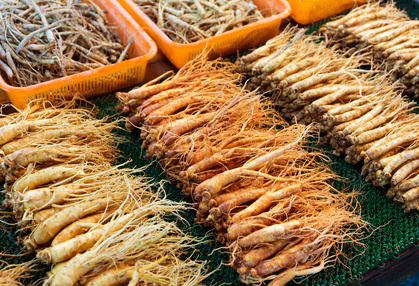
After all, the root of this herb, much like the mandrake, often has an anthropomorphic shape, and the more it resembles a human, the better its healing properties and the greater its power are believed to be. Large, old roots shaped like a man with an erect penis have always been considered the most effective and the most expensive. Although this description of the mythical ginseng root smacks of legend, it’s hardly surprising, given that it has been used as Asia’s most effective remedy for nearly 5,000 years. Modern medicine fully confirms its medicinal properties.
Health Benefits
Ginseng has a wide range of uses, which is why, according to Dr. Lazarev, it is classified as an adaptogen—a plant substance that has no specific effect on any particular organ or disease but acts on the body in a stimulating and tonifying manner, enhancing health and vitality. Taking ginseng invigorates the body, improves all vital functions, metabolism, and blood circulation; it revitalizes memory, thinking, and energy management; it brings the body into balance; it eliminates exhaustion; and as a result, a person feels healthier overall. Its aphrodisiac properties have also been highly valued since time immemorial. It is used in many stimulating preparations, medicines, and teas. It is suitable for combination with other stimulating substances, such as green or yellow-green tea (oolong), ginger, or licorice.
GINSENG
According to Modern Science
According to medical research, it restores impaired vision and hearing, aids in tissue regeneration and wound healing, and is used in the treatment of anorexia and diabetes. It stimulates blood formation and lowers blood pressure in cases of hypertension. Good results are also achieved in cases of impaired nutrient perfusion in the body caused by atherosclerosis.
According to Chinese medicine
Ancient texts describe it as follows:
“Ginseng strengthens the body’s five major organs—the heart, spleen, lungs, liver, and kidneys. It calms the mind, harmonizes the soul, suppresses fear, and wards off evil forces. It brings radiance to the eyes, clarifies thoughts, and, when taken regularly, strengthens the body and thereby prolongs life.”
Radix ginseng
The most sought-after is the root of wild ginseng, which grows in the mountains. Ordinary people are said to be unable to find it. Only the Spirit of the Earth, a man of the root, knows the way to it... Perhaps that is why ginseng is now being cultivated. However, it grows slowly, and its potency increases with age. It grows about 1 cm per year. Roots that are 5–7 years old are considered medically effective. You can determine the age of ginseng by its neck. The more circular wrinkles it has around the head (stem), the older it is.
Red root —chong-sam—is a steamed, unpeeled root.
The white root—pak-sim—is the dried and peeled root.
The pharmacodynamic effects of the active ingredients are equivalent in both. Differences arise based on growing regions, harvest time, and various external influences.
Three Types of Ginseng
ASIAN GINSENG Panax ginseng
It originates from East Asia, from the forested slopes of Manchuria and Korea. The root grows up to 50 cm. After drying, it is very hard and durable. Above ground, it has dark green, five-lobed leaves and white, umbel-shaped, hermaphroditic flowers. It is the most invigorating and stimulating variety.
AMERICAN GINSENG Panax quinquefolius
It is an endemic species found only in North America. Native Americans were also aware of its aphrodisiac effects and often used the root as a love charm. Its active ingredients are similar to those of the Asian species. However, it has a calming and cooling effect.
SPINY ELEUTHEROCOCCUS Eleutherococcus senticosus
Siberian ginseng is also called Taiga Root or even Devil’s Bush. It grows in the steppe regions of Siberia and on the Japanese island of Hokkaido. It effectively promotes balance and combats stress and aging.
Usage and Preparation
A small amount of fresh root (just a few grams) can be chewed into a paste and swallowed slowly.
A tincture is prepared by steeping 20–30 g of root (preferably still fresh) in 1 liter of alcohol, such as vodka or cognac, for an extended period. The root is steeped for about 3 months. The extract becomes even more effective with longer steeping. According to very old recipes, ginseng is also added to wine. Ginseng wine was one of the oldest remedies in ancient China. Pieces of dried ginseng are also commonly added to soups.
To make the liqueur, blend the root while it is still fresh and pour vodka over it. Shake the mixture daily, making sure the root remains submerged to prevent fermentation. After 2–3 weeks, strain the liqueur and take half a teaspoon daily. Connoisseurs may add a little sugar syrup to the liqueur.
Instant and powdered teas are brewed with hot water and steeped briefly. If preparing tea from grated or chopped dried root, pour about 3 dl of boiled water over 5–7 g of ginseng and keep the infusion at 80–90°C for about an hour. The tea will then keep in the refrigerator for several days. Sip it little by little. It is very effective. Ginseng powder or pieces can also be used as an ingredient in various other teas. Pieces of dried ginseng are also commonly added to soups.
Be sure to avoid letting the ginseng come into contact with metal during preparation. We recommend using glass containers for cooking.
We also discuss ginseng, its effects, and experiences with it in our next article , “Korean Red Ginseng—The Root of Life and Its Beneficial Effects”

Text and photo:
RNDr. Vladimír Ondejčík, RNDr. Alena Ondejčíková
Bonsai Center Nitra, Tea House of Good People
Nitra