SK
 CZ
Why We Need to Take Omega-3 Seriously Today
While we’re all familiar with vitamin C and take magnesium for cramps, we often can’t even name omega-3s—let alone understand their importance.
Yet they play a key role in the health of the brain, heart, immune system, joints, and blood vessels.
And omega-3 deficiency is so widespread today that experts liken it to a nutritional pandemic.
Why should this matter to you?
Chronic inflammation, depression, cardiovascular disease, ADHD, and pregnancy complications— all of these may be linked to a deficiency in EPA and DHA.
And while cholesterol and sugar are discussed daily, few people pay attention to the balance of fatty acids in their diet—and that’s a big mistake.
Important:
Not all omega-3s are the same. Not every bottle with a fish on the label contains what your body really needs.
In this article, I’ll show you why omega-3 is the elixir of the modern age, how to recognize a high-quality product, and how you can improve your health at the cellular level.

Omega-3, 6, and 9—Differences, Balance, and Myths
When people hear “omega,” most have no idea that there are different types: omega-3, omega-6, and omega-9 —each has its own function in the body, but their balance is key.
Omega-3s are so-called ESSENTIAL fatty acids—this term means that the body cannot produce them on its own.
Anti-inflammatory, regenerative, and essential for the brain, heart, vision, and cell membranes. We cannot produce them on our own; we must obtain them through food. They contain: ALA, EPA, DHA (more in the next chapter).
Omega-6
They are found in most vegetable oils (sunflower, corn, and soybean). In small amounts, they are beneficial, but in excess, they cause inflammation. The problem is that most people consume 15–25 times more of them than omega-3s!
Omega-9
They are found in olive oil and nuts. They are monounsaturated fats that the body can also produce on its own. They have certain benefits (for the heart and cholesterol), but they are not essential like omega-3s.
The problem with today’s diet is the extreme predominance of omega-6 over omega-3.
Ideal ratio: 1 : 1 to 4 : 1 (omega-6 : omega-3). Actual ratio in the Western diet: 15–25 : 1
This imbalance leads to: chronic inflammation in the body, a higher risk of cardiovascular disease, impaired brain function, and a weakened immune system
Therefore, the problem isn’t that we eat fats. The problem is what kinds of fats we eat and in what ratio.

3. ALA, EPA, DHA—Who’s Who and What Do They Do in the Body?
Not all omega-3 fatty acids are the same. We most commonly encounter three abbreviations: ALA, EPA, and DHA. These three “stars” belong to the omega-3 family, but each has a different role—and a completely different level of effectiveness.
ALA (alpha-linolenic acid)
It is found in plant sources: flaxseed oil, chia seeds, and walnuts. It is essential —the body cannot produce it on its own. The body can partially convert it into EPA and DHA, but only in minimal amounts: about 5–10% into EPA and less than 2% into DHA! ALA is important, but it’s not enough— especially not for the brain, eyes, and heart. That’s why relying solely on plant-based oils is insufficient.
EPA (eicosapentaenoic acid)
It is found primarily in fatty fish and fish oil. It has powerful anti-inflammatory effects —it protects blood vessels, joints, and the skin. It supports heart health and immunity and regulates triglyceride levels. It helps reduce the risk of depression, autoimmune diseases, and chronic inflammation.
DHA (docosahexaenoic acid)
It is the main structural component of the brain, the retina, and sperm. It is crucial for the development of the nervous system in fetuses and infants. It is essential for memory, concentration, vision, and protection against neurodegeneration.
Children with low DHA intake show an increased incidence of attention and behavioral disorders, as well as poorer academic performance.
In adults with DHA deficiency, the risk of dementia, depression, and Alzheimer’s disease increases .
Why is EPA + DHA from fish irreplaceable?
Plant-based omega-3s (ALA) are insufficient —conversion to EPA and DHA is poor.
EPA and DHA are directly available only from animal sources (fish, marine plankton).
Therefore, high-quality fish oil is the only effective way to obtain these two nutrients.
That’s why we’ve sourced Vesantech Omega-3 Extra Strong fish oil:
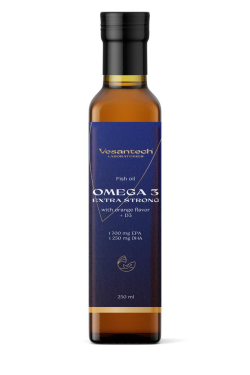 BFVesantech Omega 3 EXTRA STRONG Fish Oil 250 ml
Premium omega-3 with extra-high levels of 2000 mg of EPA and 1000 mg of DHA.
44,00 €
2,000 mg of EPA + 1,000 mg of DHA per daily dose. That’s several times more than in standard fish oils available on the market.

4. Fatty Acid Imbalance—The Silent Killer of Western Civilization
The Western world is not threatened by a lack of fats. We are threatened by an imbalance of fats.
Today’s diet is literally overflowing with omega-6 fatty acids, which, in excessive amounts, promote inflammatory processes in the body. We live in a world of fast food, where omega-6 fats are used on a massive scale. The problem isn’t that omega-6s are “bad.” They’re important in and of themselves. The problem is that they’re so abundant that they completely crowd out omega-3s from our diet.
The Ratio That Kills
I’ll repeat this once more, because it’s important: the ideal omega-6 to omega-3 ratio is 1:1 to 4:1. The actual ratio in today’s typical diet is 15:1 to 25:1. This extreme imbalance leads to what’s known as chronic, low-grade inflammation —a silent condition we may not even be aware of, but one that significantly:
weakens the immune system, accelerates aging, reduces energy, and opens the door to lifestyle-related diseases.
Inflammation as the Common Denominator
Chronic inflammation underlies most modern diseases, such as: cardiovascular disease, type 2 diabetes, obesity, neurodegenerative diseases (Alzheimer’s, Parkinson’s), autoimmune disorders, and accelerated cellular aging (oxidative stress, DNA damage)
The nutritional paradox:
People today are careful about cholesterol, sugar, and calories. But almost no one pays attention to the omega-6 to omega-3 ratio. And yet, it is precisely this ratio that can determine whether our cells live in balance or in a state of inflammation.
What’s the solution?
Reduce omega-6 intake (sunflower oil, corn oil, fast food, processed foods); reduce sources of inflammation (stress, alcohol, excess weight, toxins). And most importantly: increase intake of high-quality EPA and DHA —ideally from purified fish oil.

5. Omega-3 for a Child’s Brain Development—Critical Periods and the Consequences of Deficiency
A child’s brain isn’t built from sugar. It’s built from fats. And among the most important are omega-3 fatty acids—especially DHA.
DHA—the building block of the brain
DHA makes up as much as 40% of the fats in the brain and 60% in the retina. It is essential for the development of the nervous system, learning, memory, vision, and attention. Without sufficient DHA, brain cells literally cannot develop properly.
Critical periods when DHA is absolutely essential: pregnancy —especially the third trimester (when the fetal brain grows the fastest); breastfeeding —DHA is passed through breast milk; and early childhood —a period of intense growth, cognitive development, and behavioral formation
What happens when there is a DHA deficiency?
A DHA deficiency leads to poorer concentration and learning ability, behavioral disorders, and increased hyperactivity (ADHD). There is also an increased risk of allergies and a weakened immune system, impaired visual development, and a higher risk of neurodevelopmental disorders (e.g., autism—recent research suggests a link, particularly to DHA deficiency during pregnancy). Of course, this is not the only cause.
The responsibility doesn’t lie solely with the mother
Pregnant and breastfeeding women often do not get enough omega-3 in their diet. Standard “prenatal vitamins” contain negligible amounts of DHA (e.g., 100–200 mg). However , the actual daily requirement is at least 500–1,000 mg of DHA, and preferably more. The maximum daily dose, however, should not exceed 3,000 mg of omega-3 in total.
For an adult, the ideal dose is 2,000–3,000 mg of omega-3; this is already considered a “therapeutic dose,” at which a person will clearly feel the positive effects of omega-3 on their body.
High-quality fish oil is the only solution:
EPA + DHA in the form of fish oil is ideal for both mother and child; use highly purified oils—these are free of mercury and toxins. Highly purified, modern-processed fish oils no longer have a strong fishy odor
A healthy brain begins even before birth. And it simply isn’t possible without DHA.

6. Not all omega-3s are created equal—why form, dosage, and purity matter
It’s not enough for the label to say “omega-3.” What matters is how much EPA and DHA it actually contains—and in what form.
Most supplements on the market are underdosed!
Many common fish oils on the market, for example, contain 180 mg of EPA + 120 mg of DHA per capsule. To reach a therapeutic dose (e.g., 2,000 mg of EPA), a person would have to take as many as 10 capsules a day. Furthermore , they often contain heavy metals, oxidized fats, or have an unpleasant odor and cause acid reflux.
What to look out for when choosing omega-3:
a) Actual EPA and DHA dosage—don’t buy fish oil based on the total amount of oil (e.g., “1,000 mg of fish oil”). Check carefully: how many mg of EPA and DHA are contained in the daily dose.
b) Form: triglyceride vs. ethyl ester—digestive enzymes process the triglyceride form more efficiently (natural, similar to fats in food); the ethyl ester form (cheaper, synthetic) has lower bioavailability
c) Biomimetic form of omega-3— The phospholipid form of omega-3 (e.g., in krill oil) mimics the natural way in which fats and omega-3s are incorporated into cell membranes. “Biomimetic” thus means mimicking natural biological structures or processes in the body. Omega-3 fish oil contains less than <1% phospholipids, while krill oil contains up to 65% phospholipids. The body thus recognizes these fats as “its own” and is able to quickly and efficiently incorporate them into cell membranes, where they support flexibility, signal transmission, and mitochondrial activity. Unlike conventional omega-3s from fish oil (which are in the form of triglycerides and must first be enzymatically broken down), the phospholipid form derived from krill is absorbed directly —without loss and without reflux. This is why it is referred to as the “smart form of omega-3, ” which works in harmony with our body’s biology.
d) Oxidation (yellowish odor, fishy aftertaste)—fish oil should be pure, clear, and free of fishy odor (of course, the oil on the surface of the bottle may oxidize and develop a fishy smell). Oxidized oil can be pro-inflammatory and puts a strain on the liver
e) Certification and testing for heavy metals— especially important for products intended for pregnant women, children, and seniors. Buy fish oil that is certified for purity and origin of the raw material
Real-world example:
Omega-3 Extra Strong from Zdravý Svět, daily dose: 2,000 mg EPA + 1,000 mg DHA, in pure triglyceride form, free of heavy metals, certified, and suitable for pregnant women and children. Liquid form for excellent absorption and easy dosing
Not all omega is created equal. Just as not all gasoline is the same— fat, too, can be either premium fuel or toxic waste.
WARNING: Fish oil OXIDATION!
Conventional purified fish oil is highly susceptible to oxidation in the stomach when exposed to stomach acid. In vitro models simulating human digestion have repeatedly shown that omega-3 polyunsaturated fatty acids (PUFAs) undergo significant oxidation as early as the gastric phase, resulting in the formation of primary and secondary oxidation products such as malondialdehyde (MDA) and 4-hydroxy-2-hexenal (HHE). Oxidative stress in the stomach is most pronounced at high concentrations of EPA and DHA.
It is not sufficient to rely solely on the body’s endogenous antioxidant mechanisms. The presence of antioxidants in the supplement itself (e.g., tocopherols, natural polyphenols) significantly reduces the rate of oxidation during digestion and increases the bioactivity of omega-3 fatty acids. The addition of antioxidants is therefore recommended, especially if the goal is to maximize bioavailability and minimize the formation of toxic oxidation products.
In terms of protecting omega-3 fatty acids (EPA/DHA) from oxidation, natural polyphenols are among the most effective, particularly hydroxytyrosol and oleuropein from high-quality extra virgin olive oil. Therefore, if you are not taking antioxidants separately, we recommend combining fish oil with high-polyphenol olive oil (e.g., containing 611 mg/kg of polyphenols), which naturally supports the stability of omega-3s. EVO².
7. Omega-3 and Blood—Why They Can Replace Blood-Thinning Medications
“Your blood is too thick; we’ll prescribe blood-thinning medication.” More and more people over 50 are hearing this. But few people know that there’s also a natural way to keep blood at a healthy viscosity— without chemical medications.
How do omega-3s affect the blood?
They reduce platelet clumping (antiplatelet effect). They help keep the blood “thin” and flowing freely. They lower blood viscosity —thereby reducing the risk of clots and embolisms. They have a mild vasodilatory effect —they widen blood vessels and improve blood flow
What is extremely important:
EPA and DHA affect blood circulation so strongly that, at high doses, it is even recommended to consult a doctor —especially if you are already taking medications such as warfarin or aspirin.
Omega-3 vs. blood-thinning medications:
| Property | Medications (e.g., Anopyrin) | Omega-3 |
|---|---|---|
| Reduce blood clotting | ✔️ | ✔️ |
| Reduce inflammation | ❌ | ✔️ |
| Nourishment for cells | ❌ | ✔️ |
| Risk of bleeding | ⚠️ higher | ⚠️ low |
| Supports the brain/heart | ❌ | ✔️ |
| Side effects | Common | Minimal |
Who should take this?
People at risk of thrombosis, stroke, or heart attack, as well as diabetics , smokers, overweight individuals, and seniors with poor circulation in the extremities or “thick blood”
Consistent use of omega-3 (especially EPA) is a scientifically proven way to prevent cardiovascular events— and often allows doctors to reduce doses of chemical blood-thinning medications.

8. Interesting Facts and Trivia About Omega-3
The Inuit paradox—have you heard of it?
The Greenland Inuit (Eskimos) consume an extremely high-fat diet of marine animals, yet they have an exceptionally low incidence of heart disease. The secret ? High intake of EPA and DHA from seals, fish, and whales—and almost no refined sugar or omega-6.
Children who consume omega-3s have better learning abilities, higher IQs under the same conditions, a lower incidence of attention deficit hyperactivity disorder (ADHD), and better social adaptation (studies have also examined autism and speech development).
Omega-3 Index Test
There is a laboratory test that measures the percentage of EPA and DHA in the cell membranes of red blood cells. The ideal omega-3 index is 8% or higher. The average for the general population? 3–4% = high risk of heart and brain diseases.
The brain is 60% fat
And a significant portion of that is DHA. Without it, the “onboard computer” literally slows down: poorer memory, mood, performance, and concentration.
Which fish are highest in omega-3s?
Top sources (wild-caught, not farmed), such as sardines, mackerel, salmon, herring, anchovies, and cod liver. However, they often contain mercury, PCBs, and other toxins— which is why purified fish oil is often safer.
Common mistakes:
People think that plant-based oils, such as flaxseed or hemp oil, are sufficient —but these contain only ALA, not EPA and DHA. Many buy cheap capsules without knowing what they actually contain. Others think that the oil is just “for the joints” —when in fact it is essential for cellular nutrition.
Omega-3 isn’t a dietary supplement. It’s nutrition in and of itself.
Recommendation: Why You Shouldn’t Wait to Start Taking Omega-3s “Until Things Go Wrong”
We don’t need omega-3s only when things go wrong. We need them even before anything goes wrong.
Modern life is a real battlefield for our cells—stress, inflammation, fast food, bad fats, chemicals, and a toxic environment. And it’s omega-3s —especially EPA and DHA —that are our natural tools for survival, for the heart, brain, blood vessels, eyes, and immune system… and even for the baby you may be carrying right now.
A summary of the most important points:
Omega-3s aren’t just “for your joints”—they’re the molecules of life. Not all omega-3s are the same —the dose, form, and purity matter. Vegetable oils aren’t enough —EPA and DHA are found in sufficient quantities only in high-quality fish oil. Chronic diseases don’t arise by chance —they’re often the result of a long-term nutritional deficiency.
The brain, eyes, heart, and blood—all need omega-3s to function. Your body is your only true home. And omega-3s are its essential safeguard. Don’t underestimate what you can’t see—but what can determine how long and how well you’ll live. Omega-3 is a cornerstone of longevity and the prevention of many diseases.
Photo by Lilia Arslanova, Bernd Hildebrandt from Pixabay AI-generated photos,