SK
 CZ
His father was a preacher, poet, writer, and self-taught philosopher. He was noted for his extraordinary memory. Tesla’s mother surpassed her husband in many ways. For example, she could recite entire volumes of German, Italian, and French poets from memory without a single mistake, even though she could neither read nor write and had to rely solely on the recitations of others. She made her household chores easier by constructing various devices and tools.
Tesla, too, easily learned many languages and had been testing his inventive talent since the age of five. As a child, he suffered from disturbing visions accompanied by flashes of light. Unfamiliar objects also appeared to him. If someone uttered a single word in his presence, it immediately materialized in his imagination as a concrete image. Later on, he no longer needed any models of his technical devices. They appeared in his mind in their final form...
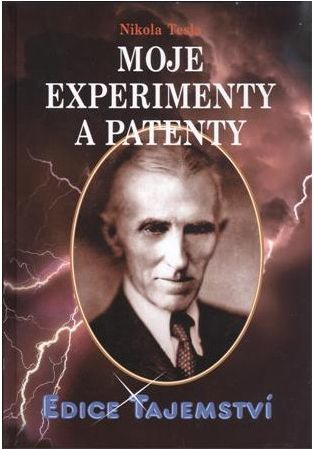
The book contains a wealth of photographs from Tesla’s personal life. The author describes adventurous and dangerous experiments with high-frequency, high-voltage alternating current, as well as his first patents, methods of wireless energy transmission, and his most significant inventions and discoveries. Tesla’s narrative style is captivating. The book offers the experience of an enthralling encounter with a genius even to readers who are not interested in the world of technology.
Excerpt from the book
Experiments with high-frequency, high-voltage alternating current.
Of all types of research into electrical phenomena, experiments with alternating current are the most interesting. This is because they lead to very promising results in a very short time. Progress in this field of applied science has been so great in recent years that it has surpassed even the boldest expectations. No sooner do we describe one aspect of the subject than we are confronted with new findings, and new avenues of research open up before us. In fact, we have already managed to achieve results that we previously did not even dare to dream of. Just as we encounter the ubiquitous rising and falling wave-like motion in nature, so too do electrical waves play a decisive role in the field of alternating current.
The reason for the rapid development of scientific fields dealing with electricity is the direct path from experiment to practical application. We wrap a simple iron ring with a coil, connect it to a generator, and immediately—with excitement and wonder—we can observe the forces we have generated, which allow us to freely transform, transmit, and control energy along specific paths. If we connect the electrical circuit correctly, the material consisting of iron and wire begins to behave like a living entity, moved by a force originating from a great distance. We observe the energy of alternating current flowing through the wire and manifesting itself in a very surprising way. However, not in the wire itself, but in its surroundings, where the energy takes on thermal, light, and mechanical forms and even manifests as a chemical reaction. All these experiments fascinate us and fill us with an intense desire to learn more about this phenomenon. Every day we come to the laboratories hoping to discover something that will advance our understanding yet another step. We constantly throw ourselves into new tasks with enthusiasm. And even though we are not always successful, our work is by no means in vain, for it brings us great joy, and we can devote all our efforts to serving humanity.
We have many experiments involving alternating current to choose from. However, it won’t be possible to demonstrate all of them. Tonight we’ll focus on just a few of them—and these aren’t even among the most unusual ones. Yet they are all certainly interesting and exciting. Here I have a simple glass tube from which the air has been partially evacuated. I take it in my hand and touch a wire through which high-voltage alternating current flows. The tube in my hand glows brightly. No matter how I move it around the room, its soft, pleasant light maintains a constant brightness.
And here I am showing you a vacuum light bulb connected to a single wire. As I stand here on this insulated pedestal, I take the light bulb in my hand, and the platinum filament inside begins to glow intensely.
Now take a look at the light bulb connected to a wire through which current is flowing. When I touch the metal base, the bulb fills with light that glows in enchanting colors.
In the next experiment, you’ll notice two wire mesh plates, which I’ll connect to the coil’s terminals. I’ll move them slightly apart and turn on the coil. As you can see, sparks jump between the plates. Now I’ll insert a thick sheet of high-quality dielectric material between the two plates. Instead of completely preventing the discharge, as one might expect, the discharge actually intensifies and begins to resemble a glowing tuft.
After these few demonstrations, I ask you: are there any experiments more interesting than those involving alternating currents? A constant companion in all our extraordinary experiments is a device well known to everyone—on the one hand a toy, but on the other a thing of monumental importance—yes, I am referring to the induction coil. Electrical engineers know of no more beloved device. Everyone, from the most experienced among us down to the young student, has surely spent many joyful hours experimenting with the induction coil. We have observed its antics and marveled at the magnificent phenomena unfolding before our very eyes. Everyone is familiar with this device, and I almost feel that I shouldn’t have dared to step before such a distinguished audience with such an old, albeit slightly modified, invention. We expected some results; others surprised us, but all deserve our attention, for in scientific knowledge, every discovery is the starting point for the next experiment. And every new reality can pave the way for significant inventions.