SK
 CZ

During the summer solstice, the sun is at its strongest and the days are the longest of the entire year. It is the most powerful and beautiful celebration of Mother Earth’s energetic rhythm.
In times when people still lived in close connection with nature, following its rhythms and laws, honoring natural beings, and communicating with angels, they used this night for the most powerful magical rituals.
Remnants of these rituals have been preserved in our folk traditions, in the dances and songs of our ancestors, and in fairy tales and legends: St. John’s herb, gathered at midnight on St. John’s Day, will drive all witches out of the house; bring home St. John’s wort gathered on St. John’s Day, rub its red sap on the threshold of your home, and you will be protected from evil forces all year long. Whoever ties the plant around their neck will see the evil forces flee.
It was also used as incense to protect against lightning and bad weather. The most beautiful legend explains why St. John’s wort contains a red pigment. This pigment is called “St. John’s blood” because, according to the legend, the furious Herodias—when St. John the Baptist’s head was brought to her on a platter—pierced the saint’s tongue in a fit of rage because he had not kept her evil deeds secret. From the blood that spattered the ground, a herb grew whose leaves, shaped like a pierced tongue, serve as a reminder of this cruel act.
One of the “pagan” rituals was the burning of and jumping over St. John’s fires, which were believed to possess protective and purifying powers. Since all energies intensify during this time, it is an excellent period for inner purification and spiritual self-work. Symbolically, we burn our old selves and dedicate ourselves to the powers of Mother Earth, who can guide and protect us, and who provides us with everything we need for life on Earth.

The herb associated with “Midsummer Night” is St. John’s wort (Hypericum perforatum). It blooms during this time, and its power is at its peak during the summer solstice. If we want St. John’s wort oil to be a beautiful red color, let’s not miss the opportunity to gather it during these very days. After St. John’s Day, its potency begins to decline. Paracelsus, the most famous physician of the Middle Ages, considered it the best medicine in the world. Its range of applications is truly very broad, and modern phytotherapy continues to discover new ways to use it.
Since ancient times, it has been used as a natural remedy for anxiety and depression. Modern science has confirmed that generations of folk healers were right. Clinical studies have shown that treatment with hypericin—the active ingredient in St. John’s wort—leads to significant improvement in cases of depression, anxiety, and feelings of hopelessness. Several studies confirm that St. John’s wort is a more potent antidepressant than commercially produced medications, such as amitriptyline or imipramine (J.A. Duke—The Green Pharmacy).
Furthermore, it has fewer harmful effects—or, more precisely, no side effects at all. St. John’s wort also improves sleep. Insomnia is a common symptom accompanying depressive states. However, it must be taken for four to six weeks. St. John’s wort should not be taken by pregnant women, and during treatment, one should avoid sun exposure, as its active ingredients can cause increased sensitivity to sunlight. It can also be used in cases of hypothyroidism, a thyroid disorder, to treat the associated symptom of depression. St. John’s wort inhibits a chemical reaction in the body known as monoamine oxidase.
It acts as a tranquilizer in the body, relieving mental tension, calming the mind, and simultaneously strengthening the nervous system.
Studies on HIV treatment are particularly interesting. St. John’s wort contains hypericin and pseudohypericin, antiviral compounds that, in test-tube studies, have been shown to be active agents against cytomegalovirus infection, one of the many comorbidities affecting AIDS patients.
Among St. John’s wort’s other potential uses, I would mention its anti-inflammatory and antispasmodic effects on liver and gallbladder diseases. The flavone glycosides it contains soothe the mucous membranes of the mouth, stomach, and intestines, and help with hyperacidity, gastritis, and stomach ulcers. It also contains phytoncides, which have antimicrobial effects.
The Herbarium of Medicinal Plants (Janča - Zentrich) lists the following constituents of St. John’s wort: catechin tannins, flavone glycosides, rutin, quercetin, essential oil, the red pigment hypericin, resins, organic acids, provitamin A, vitamin C, and others.
Even these giants of European phytotherapy rank St. John’s wort first among medicinal herbs
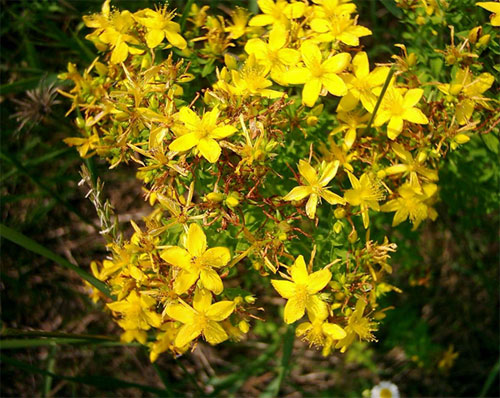
In addition to its antidepressant effects, it is also an excellent antibiotic, purifies the blood, supports metabolism, has strong anti-inflammatory effects, and treats most forms of eczema, including severe cases. Results are seen after six to eight weeks of treatment. It heals damaged tissue and alleviates swelling, bruises, wounds, contusions, and fractures.
It treats the lungs, pancreas, and, in milder cases, the liver. It is also suitable for use in anti-inflammatory teas for the kidneys. It also treats hemorrhoids. We apply it both internally and externally; in more severe cases, it is also used in the form of therapeutic enemas. It acts as a mild cardiotonic. After a stroke, we use it in rehabilitation in the form of compresses and massages (St. John’s wort oil). It stops internal bleeding and improves vascular health. When used long-term, it is a key herb in the treatment of multiple sclerosis. For other indications, it is not administered long-term.
The usual dosage form is an infusion, administered in small doses, typically 125 ml, 2–4 times a day. Recipe “for the nerves”: 100 g of marjoram, 50 g of St. John’s wort, 50 g of narrow-leaved chickweed, 25 g of heather, 25 g of calendula flowers.
The most effective form is a tincture, with a wide dosage range from 10 to 40 drops, depending on the condition and the body’s state.
St. John’s wort oil is obtained by macerating the flowering tops in high-quality olive or sunflower oil for 14 days in a sunny spot, stirring daily with a non-metallic object. It is used for massages to treat various types of neuralgic pain, sciatica, tennis elbow, and similar conditions.
You can also prepare St. John’s wort wine (use only organic wine): Pour 1 liter of high-quality white wine over 30 g of St. John’s wort flowers and let it macerate for 14 days. Filter it, then take one liqueur measure before lunch and dinner. It is particularly effective for asthma, especially its nervous symptoms.
If you go out to gather the magical St. John’s wort, remember that the best time to harvest it is early in the morning, right after the dew has dried. Be sure to pick St. John’s wort with a spotted stem; it must have a curved, almost elliptical stem. Do not pick herbs with a square stem, as they have weaker therapeutic effects and are less effective.
I wish you a wonderful adventure with the magical herb of St. John.
Mgr. Iveta Henzélyová www.bylinkovaskola.sk
References for this article: Jiří Janča, Josef A. Zentrich – Herbarium of Medicinal Plants, published by Eminent
J.A. Zentrich – The Third Path to Health, published by Fontána
Dr. Dimiter Pamukov, Prof. Christo Achtaradžiev – The Natural Pharmacy,
published by Príroda
James A. Duke – The Green Pharmacy, published by PWP