SK
 CZ
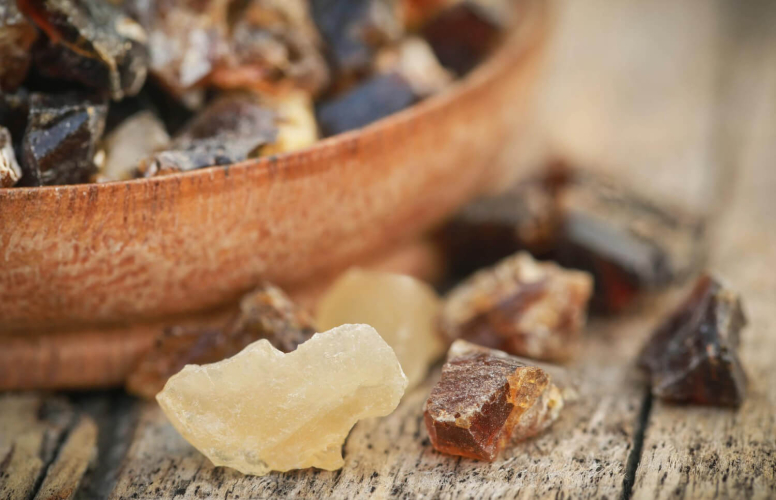
Which types of incense can you read about in the article?:
- Kyphi
- Elemi
- Benzoin (Siam, Sumatra)
- Guggul (Commiphora mukul)
- Almond (Resina amigdalis)
- Myrrh (Commiphora myrha/Commiphora molmol/Commiphora abyssinica)
- Jasmine (Jasminum grandiflorum)
- Frankincense (Boswellia carteri/Boswellia sacra/Boswellia serrata)
- Peruvian balsam (Myroxylon balsamum, var. Pereiare)
- White sage (Salvia apiana)
Kyphi
It was the most famous and rarest incense of ancient Egypt, which was exported at that time to the entire known world.
Kyphi incense was used to purify spaces, but we can also use it during meditation and prayer. It is particularly well-suited for evening burning; it washes away worries and creates a pleasant and relaxed atmosphere.
It consists of many ingredients; its preparation was complicated and took a very long time. It was produced in temples under the guidance of priests, accompanied by prayers and magical rituals.
Scent: sweet, harmonious, complex, multi-layered, with an oriental touch, smooth and noble
Elemi
This is the collective name for a group of resins derived from plants belonging to the balsam family (tropical Asia). In our region, resin from the Philippines is sold. Elemi releases a very light, pure smoke, reminiscent of mastic. It refreshes, inspires, sharpens the senses, purifies the air, and improves mood. It energizes and clears the mind.

Benzoin (Siam, Sumatra)
Styrax tonkinensis/Styrax benzoin—benzoin from India is yellowish-brown, while that from Indonesia and Indochina (Sumatra) is brown. It is obtained in the same way as frankincense, by making incisions in the tree trunks. Siamese benzoin is more expensive and rarer; it is milder and, when used in excess, does not cause a coughing reflex like Sumatran benzoin does.
Both types are used in the cosmetics and food industries. In the Roman Catholic Church, it is used in anointing oils—for the anointing of the sick and last rites.
When burned, benzoin releases a light, sweet, chocolatey-balsamic scent—due to its vanillin content. It has a harmonizing and relaxing effect. It gives a sense of protection, which we can utilize when dealing with emotional wounds.
Guggul (Commiphora mukul)
A resin from India, also known as Bdellium or false myrrh. It has disinfectant and stabilizing effects—even in other forms: ointments, lozenges, and tinctures. It is a component of Nepalese and Indian incense sticks. In the past, it was very difficult to obtain. It has healing effects for respiratory ailments, emotional instability, and stress. Since ancient times, it has been used in magical and spiritual practices. It also has a mildly aphrodisiac effect; its sweet, aromatic scent acts as an aphrodisiac. It is suitable for burning in the evening; it wards off the demons of the night and induces peaceful, refreshing sleep.
Almond (Resina amygdalis)
It is obtained from almond or fruit trees, but a similar substance can also be obtained from cherry trees. It is water-soluble and is used in the restoration of works of art or in their forgery (it gives the work an aged appearance). It has properties similar to gum arabic. Even Dioscorides recommended its warming and astringent effects. He recommended it dissolved in vinegar for treating ringworm. It has a delicate fruity scent, reminiscent of caramel and nuts. It is popular in love magic.

Myrrh
(Commiphora myrha/Commiphora molmol/Commiphora abyssinica) — along with frankincense, it is one of the best-known resins. There are about 150 species of myrrh trees. They grow primarily in Somalia, Yemen, Ethiopia, and Sudan. It is yellow or gray in color. Opinions on the origin of its name vary: Myrrh was the name of a girl who seduced her father and was turned into a tree as punishment. Another interpretation—based on the Arabic word “murr”—means “bitter.”
It is frequently mentioned in the Bible—the name “Bdellium” was also used, as is “guggul” today . It was commonly used in antiquity . Today, it is an ingredient in tinctures for inflammation of the oral cavity, the oral mucosa, and open wounds. It is also an ingredient in Swedish Bitters. It has disinfectant, deodorizing, narcotic, and astringent effects. In the past, it was also used as a sedative and sleep aid. The perfume industry uses it as a fixative. In Arab countries, it is still used today as an ingredient in sweets and lemonades. It has a spicy-herbal aroma. When burned, it has significant healing effects. It is also used for protection and purification. It is a component of many blends.
Jasmine (Jasminum grandiflorum)
True jasmine was not brought from Persia to Europe until the 16th century. Its exquisite fragrance ranks it among the most expensive ingredients in the perfume industry. To obtain one liter of essence, at least two metric tons of hand-picked flowers must be pressed. They must be harvested in the early morning hours, as that is when the essential oil content is at its highest. In Indian mythology, jasmine is associated with love. Kama, the god of love, shoots jasmine arrows to awaken love in the human heart. The Chinese diffuse jasmine in the rooms of the sick to purify the air and lift their spirits. Although it has no distinctive scent, it has been used in love potions for centuries. To enhance its effect, it is recommended to apply a few drops of the essence to sandalwood.
Frankincense (Boswellia carteri/Boswellia sacra/Boswellia serrata)
Frankincense is the name used to refer to all types of resins. It is also the name for a resin called olibanum, which comes from 25 species of the Boswellia genus. It grows only in the wild. All attempts to domesticate and cultivate it have failed.
Harvesting has been carried out in the same way for 3,000 years. The bark of the frankincense tree is cut in a special way using a Mangaf knife (in ancient times, this was a closely guarded secret). Its quality is judged by its color—the lighter and brighter it is, the higher the quality.
As far back as ancient times, it was used for purification and protection against insects and rodents; people perfumed their homes and clothing with it, and it was used in religious ceremonies. Today it is also used in ointments, plasters, and teas... for asthma, depression, the flu, inflammation, intestinal disorders, skin inflammation, sleep disorders, gum inflammation, headaches, and cancer.
It clears the senses, directs one’s gaze toward what is essential, and bridges the material and spiritual realms. Its sweet, rich fragrance creates an atmosphere of crystalline purity, tranquility, and nobility.

Peruvian Balsam (Myroxylon balzamum, var. Pereiare)
The tree from which it is derived grows in Central America, primarily in Honduras, Nicaragua, southern Mexico, and El Salvador. It got its name because the global trade in this balm passed through Peru.
It is used in the production of chewing gum and chocolate, in perfumery, and is reportedly part of Coca-Cola’s secret formula. At the turn of the 19th and 20th centuries, it was used to treat frostbite. It also helps with inflamed and poorly healing wounds, as well as burns.
It is added to blends at the very end. When smoked on its own, it produces a lot of smoke. It has a wonderfully harmonious, vanilla-like scent; it feels warm and creates a sense of being enveloped. It strengthens life energy and is beneficial for a vulnerable mind.
White Sage (Salvia apiana)
White sage grows on the west coast of North America. Among Native Americans, it is considered the most sacred medicine.
It is used similarly to European sage. Rituals—sweat lodge—“where there is sage, negative forces cannot enter.”
Its scent is clear and strong, with a soft, sweet undertone. It has healing properties and protects against negative energies.
You can find our complete selection of incense in our online store HERE.
Mgr. Iveta Henzélyová, www.bylinkovaskola.sk, and Ing. Pavol Machnič,www.zdravysvet.sk