SK
 CZ
1. A Molecular Perspective on Superfoods
Greens and Reds ( green and red blends) have long been a phenomenon. They have become a symbol of a healthy lifestyle, promising an easy dose of micronutrients. This popularity is understandable, but in many cases, it’s just marketing. Modern science is now revealing that the true biological effect does not lie in the volume of ground filler, but in the purity and potency of individual molecules. The reality, however, is more complex. Many blends contain dozens of ingredients, yet only a few of them are standardized for bioactive compounds that actually regulate the body’s defense and regeneration pathways. The result is a green-and-red cocktail that’s high in filler, low in precisely targeted effects, and whose bioavailability varies wildly from batch to batch.
On paper, they look great: a long list of plants, superfoods, extracts, enzymes, and fiber. The problem is that in the human body, it’s not the length of the list that matters, but how much of the active substance actually reaches the receptors and pathways that alter biology. Often, the amount of these substances doesn’t reach the so-called “supercritical threshold” required for them to function in the body at all. Simply put, there isn’t enough of them. When a product has dozens of ingredients, each one usually appears only in a token amount. It sounds appealing, but biology operates on “thresholds”—if you don’t reach them, the body simply doesn’t pick up the signal. This creates “nutritional noise” with no clear effect. It’s as if you bought a probiotic and, instead of billions of probiotic bacteria, you only consumed a few thousand…
That doesn’t mean “greens/reds” are bad. They can serve as a practical “vegetable safety net” on days when you don’t have time to cook. They won’t hurt you, but they won’t help much either. Of course , it’s better than nothing, but we’ll show you that today’s options have far surpassed what was available 25 years ago.
The modern approach, however, is different. Instead of mixing leaves, berries, and grasses, modern science focuses on molecules with a clear mechanism of action, dosage, and data. As an example, I’ll mention sulforaphane as a top-tier activator of the Nrf2/ARE pathway, which triggers the body’s internal antioxidant and detoxification systems. I cannot forget astaxanthin either, a membrane antioxidant with an extraordinary capacity to quench singlet oxygen and protect mitochondria. This is not a “nature vs. science” debate. It is a shift from a one-size-fits-all approach to precision: mechanism → dose → effect.
Singlet oxygen (¹O₂) is an “excited” (energetically charged) form of oxygen. Unlike ordinary, stable oxygen in the air (triplet O₂), singlet oxygen is highly reactive—it readily attacks lipids, proteins, and DNA.It is formed primarily by UV radiation in the skin, during inflammation, and in the presence of photosensitizers (certain dyes and medications). It triggers lipid peroxidation (membrane damage), accelerates skin aging, and increases oxidative stress. How to “extinguish” it: so-called quenchers (e.g., astaxanthin, lycopene) neutralize it energetically —they remove its energy and convert it into heat, without necessarily being consumed themselves, unlike classic “chemical” antioxidants.

2. Why Might Traditional “Greens” and “Reds” Not Be Enough?
Traditional superfood blends thus face three main limitations that significantly reduce their benefits:
a) Poor Bioavailability: Many valuable compounds (e.g., polyphenols) are trapped within plant cell walls, making it difficult for them to be absorbed in the intestine. Furthermore, some molecules are unstable and degrade during the powder manufacturing process. There is often a lack of a technological process that would protect them and deliver them in a usable form. The result is a discrepancy between what you see on the label and what is actually absorbed and utilized.
b) High Proportion of Filler: Mixes are often dominated by cheap fillers, fiber, and sugars from fruit. The content of truly effective substances—such as glucosinolates from broccoli or astaxanthin in berries—is usually low and not standardized.
c) These blends promise everything — energy, immunity, digestion, detox— but rarely specify which cellular pathways they specifically modulate and at what dosage. Without knowing the mechanism and dosage, it’s difficult to plan synergies (e.g., with omega-3, curcumin, or coenzymes), and even harder to measure the effect.

3. The TOP among GREENS is definitely Sulforaphane
Sulforaphane isn’t just another “green powder.” Sulforaphane is one of the best “switch” molecules (Nrf2) among phytonutrients. It’s not the absolute king of everything, but it’s at the top of its category and, when properly prepared, highly effective. It is a precisely defined molecule found in cruciferous vegetables (especially broccoli sprouts) that is formed when glucoraphanin combines with the enzyme myrosinase —that is, when the vegetables are chopped, chewed, or gently blended. The point isn’t a bizarre cocktail made from dozens of leaves, but the activation of a specific cellular pathway— Nrf2/ARE—which triggers the body’s own defense mechanisms: the production of glutathione, phase-2 detoxification enzymes, and the “silencing” of inflammatory signals.
This “switch” has real consequences. When Nrf2 levels rise, cells better cope with oxidative stress, the mucous membranes and liver neutralize toxins more effectively, and tissues return to balance more quickly. It’s not a stimulant that gives you a one-hour boost; it’s an internal defense mechanism that alters the microenvironment within tissues. That’s why sulforaphane makes sense for stress-induced fatigue, sun-sensitive skin, a “foggy” head, or after periods of a diet low in micronutrients.
The key lies in its form and bioactivation. Regularly cooked broccoli deactivates myrosinase through heat; therefore, sulforaphane isn’t produced in meaningful amounts. There are three solutions: (1) sprouts (highest precursor content), (2) gentle preparation —chop and let stand for 3–5 minutes, then steam briefly, or (3) a product with standardized content and optimized bioactivation (myrosinase logic, stability, dose → effect). This is precisely why “Greens by Vesantech” does not mean green powder, but targeted sulforaphane.
In practice, it looks like this: take it in the morning or mid-morning, or use our longevity booster (let Nrf2 “run” throughout the day), ideally with a real meal.
To support long-term health, vitality, and the body’s resistance to serious diseases. 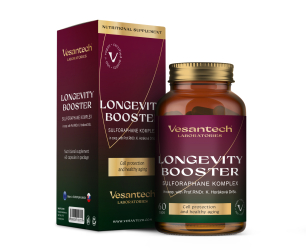
It complements omega-3 (cell membranes), liposomal curcumin (NF-κB), resveratrol/AMPK (energy metabolism), and, of course, sleep and exercise, which create conditions conducive to autophagy. Safety is generally very good; sensitive individuals may want to start with a lower dose.
To put it simply: “Greens,” as we define them, are molecules with a specific mechanism of action, such as sulforaphane. It’s not about the color of the drink, but rather the Nrf2 switch that gives tissues the chance to “hear” their own instructions again.

4. A TOP example from the “REDS” is astaxanthin
Astaxanthin is not a “red superfood powder.” It is a precisely defined xanthophyll carotenoid from microalgae (Haematococcus pluvialis) that accumulates in the tissues of marine animals (salmon, shrimp) and gives them their characteristic color. In our bodies, it acts as a lipophilic antioxidant that integrates into cell membranes and protects them from oxidative damage—especially from singlet oxygen (as I explained in the introduction) and lipid peroxidation. As a result , it not only combats “free radicals” in general but also protects the most vulnerable sites: the phospholipid membranes of cells and mitochondria, where energy is produced and where “sparks fly.”
While water-soluble antioxidants (e.g., vitamin C) act primarily in the aqueous phase, astaxanthin is at home in the lipid/membrane phase. It uniquely spans both layers of the membrane. Thanks to this “bridge” position, it can quench chain reactions of peroxidation right where they begin. In model tests for singlet oxygen scavenging, it ranks among the most potent natural antioxidants; clinical data show benefits in skin photoprotection (UV resistance), reduction of muscle fatigue markers, and improvement in lipid profile and inflammatory markers in certain groups.
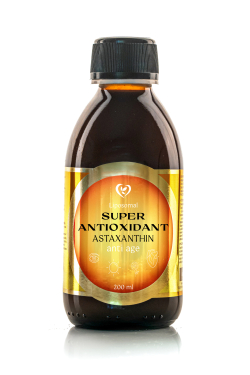
The difference compared to “red powder” lies in precision: a specific molecule, a standardized dose, consistent purity, and a clear mechanism of action (membrane protection, modulation of inflammatory pathways, mitochondrial stability). In practical terms, this means we can target specific outcomes and build synergies: combining it with omega-3 (for more flexible and resilient cell membranes), sulforaphane (Nrf2—internal antioxidant response), and curcumin (NF-κB—inflammatory response) makes biologically sound sense.
How to incorporate it into your daily routine? Take it with a meal containing fat or in liposomal form (for better absorption), ideally during periods of sun exposure (in the summer), physical exertion, or when you need to suppress oxidative stress in cell membranes over the long term.
The point is the same as with “Greens”: molecular precision is always more important than a pretty mix of colors.

5. Why are molecules more important than “greens/reds” powders?
In a living organism, it’s not the color of the drink that matters, but whether a specific active molecule, in the correct form and dose, reaches its target pathway and produces a measurable effect. With sulforaphane and astaxanthin, we know exactly what they do, how much is needed, and how to deliver them (bioactivation/absorption). This is the difference compared to broad-spectrum mixtures, where promises are made faster than data is gathered.
The mechanism is just the beginning of the story. Sulforaphane activates Nrf2/ARE—an internal defense program that increases glutathione and phase 2 detoxification enzymes. Astaxanthin embeds itself in cell membranes and protects them from singlet oxygen and lipid peroxidation, thereby stabilizing the mitochondria. With blends of leaves and berries, we usually don’t know which of the dozens of compounds has real potency, or whether there’s even enough of it.
The dose determines whether the body “hears” the signal. Blends often contain dozens of ingredients in subthreshold amounts—they look good on the label, but they don’t generate sufficient biological impact. With targeted molecules, you control the active dose and can finely adjust it according to your goal (skin, performance, stress, recovery).
Bioactivation and bioavailability are the key. Sulforaphane is only formed after glucoraphanin combines with myrosinase—without this “spark,” the effect drops sharply. Astaxanthin is lipophilic—it needs fat and a stable matrix to actually reach the cell membranes. Powdered blends often lack protection against degradation (heat, light, time), and the results vary from batch to batch.
Consistency builds trust. A standardized molecule = the same potency today and tomorrow. Botanical blends vary depending on origin, season, and storage; without strict control, you have no guarantee of reproducibility. With a molecule, you’re reaching for the same tool every time.
And finally, synergy. When we understand the mechanism, we can assemble an “orchestra”: Nrf2 (sulforaphane) for internal defense, a membrane shield (liposomal astaxanthin) for the mitochondria, plus omega-3 for membrane fluidity and liposomal curcumin to inhibit NF-κB. Not a hodgepodge, but a precisely targeted combination that you can time for the morning, a meal, or exercise.
The summary is simple: mechanism → dose → effect. These molecules allow you to work with biology as a precise system, not as a colorful smoothie.

6. Practical Application: How to Incorporate This Into Your Day (Simply and Effectively)
Morning / Mid-morning – “activate your internal defense” (sulforaphane).
Sulforaphane makes sense in the first half of the day when you want the Nrf2/ARE pathway activated during your active hours. Ideally, take it with a real meal.
With a main meal – “protect cell membranes” (astaxanthin).
Astaxanthin is lipophilic—take it with a meal containing fat (lunch/dinner) or, preferably, in liposomal form. It makes a lot of sense on days with stronger UV exposure, physical exertion, or prolonged screen time (oxidative stress in membranes/mitochondria).

7. Conclusion: Less Powder, More Precision, and Key Claims
Greens & Reds aren’t the enemy. They’re a practical “vegetable safety net” for days when you’re too busy. However, if you want a predictable, measurable effect, precision wins out: molecule → mechanism → dose → effect.
Sulforaphane activates Nrf2/ARE and quiets internal noise. Astaxanthin protects membranes and mitochondria—the very places where energy is produced and “sparks.” Combined with a rhythm of sleep, movement, and real food, this results not in a smoothie, but in a strategic protocol.
We rely on biochemistry, standardization, and consistent potency. While the market mixes leaves and berries, we work with pure science —so you can feel less noise and more performance every day.
The rest are just extra good days.
Sulforaphane: one of the most potent known Nrf2 activators, with published mechanisms and clinical evidence in the areas of oxidative stress, inflammation, and cellular protection.
Astaxanthin: a very potent membrane antioxidant with exceptional singlet oxygen quenching capacity in model tests and beneficial data regarding skin health, muscle fatigue, and endurance.