SK
 CZ
THE FIRST OF CHINA'S TEAS
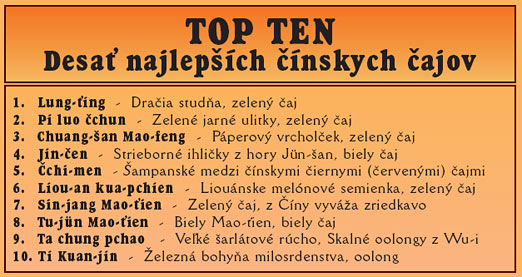
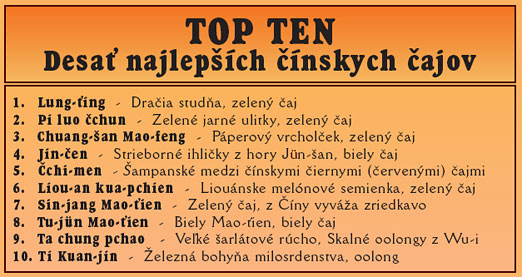
Dragon Well, Lung-jing, is prized as the best and most famous tea in China. It is also one of the traditional teas mentioned in ancient literary sources. The famous Lu Yu (733–804) writes about it in his Classic Book of Tea. Although he refers to it as Lung-hong, there is no doubt that this is the very tea that later became so famous and came to represent nearly all of China’s teas. Lu Yu, however, did not particularly highlight it in his book.
The name “Dragon Well” did not come into use until later, during the Southern Song Dynasty, when various legends and lyrical tales began to circulate about teas and the various picturesque places where they were cultivated.
THE LEGEND OF DRAGON WELL
Dragon Well tea got its name from a village nestled amid misty green mountains, near which the tea was grown; the village, in turn, was named after a monastery standing near a remarkable well, from the depths of which clear water springs. Long ago, around the year 250, a wise monk lived in these parts. When a prolonged drought gripped the entire region and the people looked helplessly at the deep-blue sky without a single cloud, at the withered leaves on the trees and the dried-up wells, the benevolent monk urged them to direct their prayers and pleas to the water dragon, the lord of all waters, who was said to dwell in the deep underground waters beneath the mountains. He, too, immersed himself in deep meditation to appease the mighty water dragon. The pleas worked, for the sky darkened with heavy rain clouds, and from the large rock against which the meditating monk’s knees rested, a powerful spring of clear water gushed forth.
The people thanked the water dragon for saving them, washed their faces with the cool water, and scooped it into pots to brew a fine tea that tasted better to them than ever before. They named the spring Dragon Well and built a shrine nearby, and later a monastery. And the tea they harvested on the mountain slopes behind the village was also named Dragon Well, so that their gratitude might be carried far into the world along with the fine tea leaves.
And even today, when you dip your hand into the spring—which is still full of water—you can see small whirlpools that ripple the water’s surface like a water dragon. People say that Dragon Well is connected deep underground to the sea, much like our legendary “sea eyes” in the Tatra Mountains. Perhaps that is precisely why a dragon lives there...
EMPEROR’S TEA
The unique Dragon Well also thrives on the slopes of Left Mountain, at the foot of which lies the village of Mej-ťia. This entire region bears the poetic name “Land of Nine Bends and Eighteen Gorges” (Jiou-chu Sh-pa-tien). Legend has it that during the Qing Dynasty, monks from the Wugong Monastery on Left Mountain cultivated and processed excellent tea. They took special care to harvest and dry the tea from the eighteen tea trees that grew in front of the monastery.
They sent the tea from these trees to the imperial court. Emperor Qianlong enjoyed the tea so much that he undertook four costly visits to these places; and in addition to savoring the unique tea and writing songs and poems about it, he also took an interest in the practical aspects of its cultivation and production so that he could spread tea cultivation throughout the country. He bestowed the title “Imperial Tea” upon Dragon Well tea, which was made from eighteen tea trees growing in front of the monastery. This made Dragon Well very famous.
ON HOT WOKS
Dragon Well tea is characterized by its unique processing and drying of the tea leaves. Immediately after harvest, the tea is transported from the plantations to the village, where tea is produced on both a large and small scale according to ancient tradition. The tea leaves are allowed to wither and soften slightly without undergoing fermentation, and then they are kneaded by hand in hot metal pans—woks—and pressed against the hot metal walls of the vessel to dry thoroughly. Tea seed oil is also used in this process. It is important to gauge the correct pressure, temperature, and duration of processing based on the current condition of the harvested tea leaves. The finished, properly dried tea leaves have a distinctive flat appearance and a jade-green color.
THE RUNNING TIGER SPRING
When preparing tea, it is very important to use the right water so that drinking tea is a true pleasure. The best tea is prepared with water from the legendary Chu-pchao (Hu-pao) spring, known as the Well of the Running Tiger. Thanks to the crystalline bedrock, the water there is very flavorful, pure, has high surface tension, and seems sweet. It is a good custom to drink tea brewed with this water when one finds oneself in this picturesque region.
Dragon Well tea is traditionally brewed in typical Chinese teapots, which provide ample space for the tea leaves to unfurl. A more modern practice is to steep Dragon Well leaves in glass teapots and cups, which allows one to comfortably observe how the leaves impart their jade-green hue to the water; however, glass cannot match the charm of Chinese ceramics and porcelain.
Dragon Well tea has a beautiful yellow-green color and a slightly sweet taste. It has a distinctive aroma and flavor. The dried tea leaves are delicate, so they must be carefully stored in a dry, dark, and cool place to preserve their delicate fragrance and unique flavor.
PARADISE ON EARTH
Dragon Well is grown near the city of Hangzhou, southwest of West Lake (Xi Hu). It is an ideal location for cultivating the finest tea, as the entire region is sheltered from cold air currents from the north and enjoys a pleasant, warm, and very humid climate. Fog rolls over the mountain slopes almost constantly, and this, combined with high-quality soil rich in phosphates, aids in the maturation of the tea leaves.
The city of Hangzhou in Zhejiang Province, near which Dragon Well tea is grown and processed, is considered one of the most beautiful cities in vast China. It was founded 2,200 years ago and reached its greatest splendor during the Southern Song Dynasty (1127–1279), when it served as the magnificent capital of the empire. For its time, it was surprisingly large—in fact, it was the largest city in the world—and bustled with lively activity.
It was also known for its many classical Chinese gardens and teahouses, where people from all walks of life gathered. Many artists, writers, and politicians came here to live—and even to die. After all, an old Chinese proverb said that there is paradise in heaven and Hangzhou and Suzhou on earth. Even the traveler Marco Polo liked it here; after all, he wrote that Hangzhou was the most beautiful and majestic city in the world. And it is right here, in this mountainous region of rolling hills and lakes, that the legendary Dragon Well is located.
TEA ACCORDING TO TRADITIONAL CHINESE MEDICINE
According to traditional Chinese medicine, Dragon Well green tea has a cooling effect and a mildly yin to neutral nature. It soothes unwanted heat in both body and mind and has a moderating and stabilizing effect. At the same time, it is invigorating and strengthens the flow of energy in the body. It enhances concentration, reduces fatigue, aids digestion, and cleanses the liver of unwanted metabolites, thereby improving vision as well. It is often used in weight-loss programs.



QING MING
The Qing Ming Spring Festival is a traditional Chinese holiday during which not only families but also entire lineages and clans gather to pay their respects and express gratitude to their ancestors. At this time of year, candles are lit in cemeteries, and the smoke from incense sticks rises to the heavens. It is precisely during this festival that the finest Dragon Well tea is harvested near the beautiful city of Hangzhou.
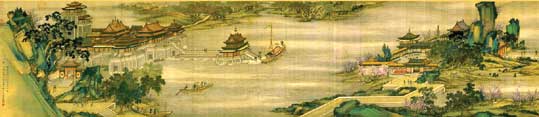
This festival was captured on an unusually long scroll titled *Life on the River During the Qingming Festival* by the imperial painter Zhang Zeduan during the Northern Song Dynasty (11th–12th centuries). The painting that accompanies our story about the Dragon Well is painted in watercolors on silk and is one of the most striking works of Chinese art.
Text and photo: RNDr. Vladimír Ondejčík, RNDr. Alena Ondejčíková
Teahouse of Good People, Nitra