SK
 CZ

There’s a lot of truth to that. The digestive tract needs rest. Why? If our digestive tract is constantly overloaded, we lose a great deal of energy and other benefits for a healthy life. Let’s break this down step by step. Eating from the moment we wake up until late in the evening means that our digestive tract is working nonstop, without much rest, for 12 to 16 hours a day.
This is currently one of the most serious problems of our modern lifestyle. Most of the population is overweight, and many people are obese. Their BMI is over 25. You might ask again: why?
It’s important to realize that when we eat a substantial meal, our digestive system consumes 70% of the energy currently available to us. When we’re awake, our brain constantly uses 20% of our vital energy. So if we eat a good meal and haven’t done anything yet, our body is already running at 90%. If we add even light physical activity to that, we’re already at 100%. What happens if we engage in any kind of vigorous activity after eating? 
The answer is that we start to draw on our energy reserves and go over 100%.
You might ask, what’s the problem with that, since our body has reserves?
The main problem is that if we frequently tap into these reserves, the body tries to build up ever-larger stores. The body’s store is fat. So we start to gain weight. In addition to weight gain, our body wears out quickly because it can’t repair itself sufficiently.
This is even more important than weight gain. If the body can’t recycle itself, it begins to age much faster.
Have you heard of the mTOR ( mechanistic target of rapamycin)switch in our body? It’s a switch that controls our body’s two basic modes: growth mode and regeneration mode. It’s the main regulator of cell growth.
The second problem lies in the fact that this internal switch should periodically toggle between these two modes. However, if we eat for long periods and in large quantities, there is little time left for the body to regenerate, and at the cellular level, cells are not recycled sufficiently. The process known as autophagy is insufficient.
Why is autophagy vital?
Autophagy is a fundamental process for the health of cells and the body. If it were to shut down completely, cells would become filled with waste, leading to their dysfunction and death. Without regular cleanup— much like the accumulation of trash in your home— the cellular environment would cease to function.
Autophagy is a mechanism of cellular recycling.
Autophagy is a catabolic process in which a cell breaks down old proteins, damaged organelles, and other cellular structures into their basic building blocks, such as amino acids. These components are then reused to form new proteins or burned for energy. Autophagy functions as a cellular recycling station. During this process, the cell scans its interior, searching for old and damaged components that can be used for repair and renewal.
We now know how to support autophagy with cutting-edge products. One of the most important is spermidine.
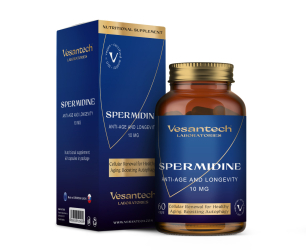
The most potent spermidine on the market for cellular cleansing and autophagy
The Role of Lysosomes: Cellular Waste Treatment Plants
The process of autophagy would not be possible without lysosomes, specialized organelles that collect old proteins, organelles, and other cellular waste, including pathogens. Lysosomes contain enzymes that break down these structures into their basic components. In addition, lysosomes destroy so-called protein aggregates—clusters of damaged proteins that accumulate over time and contribute to the development of neurodegenerative diseases such as Parkinson’s disease and Alzheimer’s disease
Autophagy failure is associated with several other pathological conditions, including:
Metabolic disorders: Impaired autophagy is associated with obesity, diabetes, and other metabolic dysfunctions. Chronic inflammation: Inadequate removal of damaged cells can trigger inflammatory responses associated with aging and chronic diseases.

Calorie restriction is therefore a key process that triggers the formation of new, more efficient mitochondria capable of replacing old and damaged ones. These new mitochondria improve the cell’s energy capacity, enabling it to produce ATP—the cell’s primary energy currency—more efficiently, even with a limited amount of available fuel. At the same time , AMPK—a key sensor of the cell’s energy status—supports fuel availability for these mitochondria. It activates glucose production in the liver (a process known as gluconeogenesis) and mobilizes fat stores to release energy from fat cells.
Conclusion: Calorie Restriction and Fasting—The Forgotten Wisdom of the Past
It is important to realize that calorie restriction is by no means a modern invention— it has deep roots in religions, philosophies, and traditional cultures around the world. Days of fasting have been a part of Christianity, Islam, Judaism, Ayurveda, and Zen Buddhism—not only as a spiritual act but also as a natural way to detoxify the body and restore balance.
Today, in an age of unrelenting abundance, we have degraded this principle through our unhealthy lifestyle—constantly eating from the moment we wake up until late in the evening, often without feeling hungry, simply out of habit. That is precisely why it is important to realize that eating until you are half-full and not overeating is the foundation of long-term vitality.
Modern science confirms that time-restricted eating (intermittent fasting) and moderate calorie restriction can trigger autophagy —an internal process of cellular renewal that helps the body rid itself of damaged structures, reduce inflammation, and promote longevity. Regular breaks from eating give the body time to regenerate, improve metabolism, support hormonal balance, and can prevent lifestyle-related diseases.
So, anyone who longs for a healthier and more mindful life shouldn’t ask, “What else can I eat?” but rather, “When and how much is naturally beneficial for my body?”
Remember, the foundation of health is an empty stomach.